


























Find business insurance quotes for your S corp
Save money by comparing free quotes from top-rated providers.

Due to the high cost of injuries and lawsuits, an accident could financially devastate your small S corp. Business insurance provides you with peace of mind by covering unexpected medical bills, attorney's fees, and property repairs. State laws, clients, and lenders may require coverage.
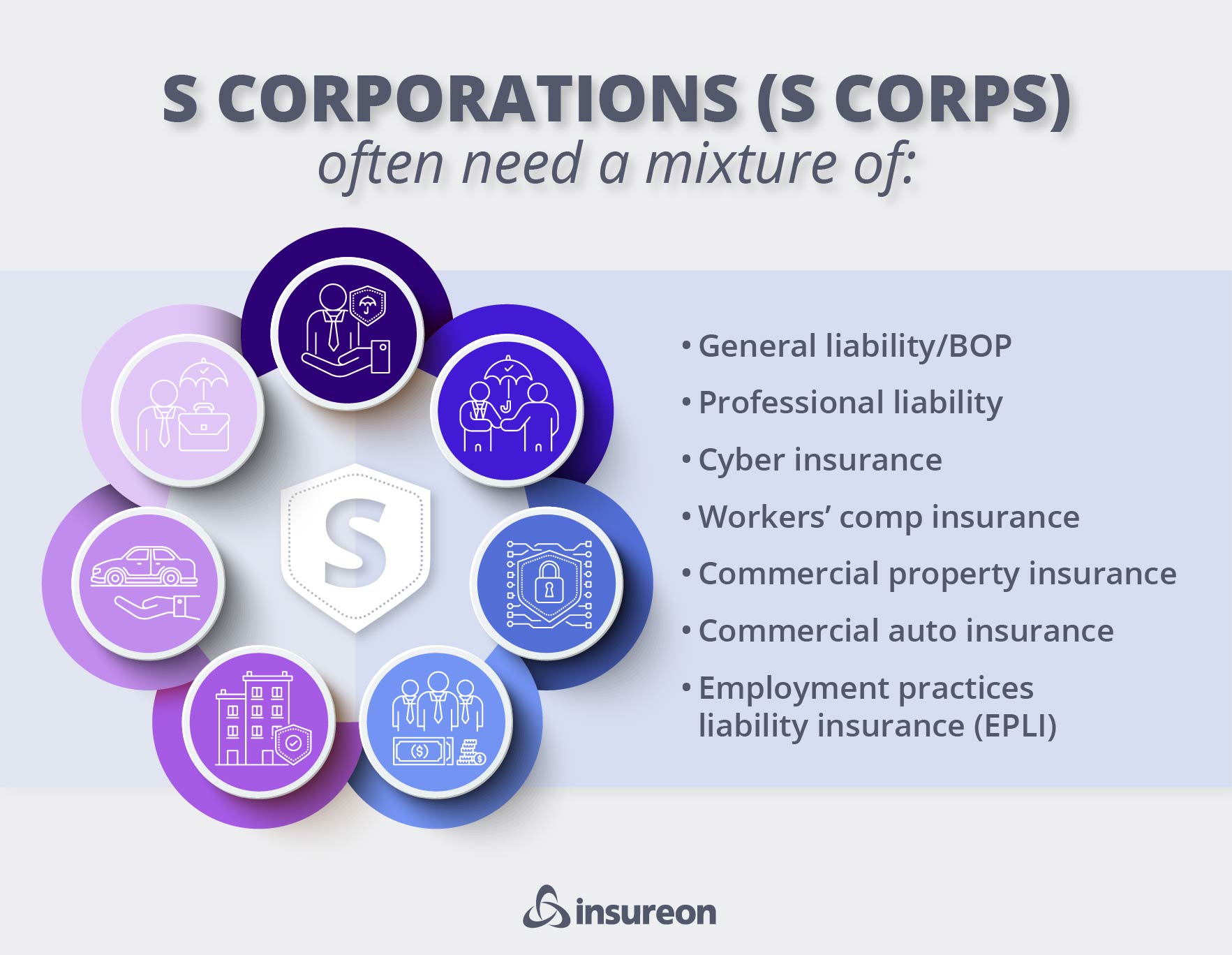
These insurance policies cover common risks faced by S corporations.

General liability insurance covers the cost of third-party accidents, such as a client who trips and suffers a bodily injury at your S corp's office. It may be required for a commercial lease.

This policy covers legal costs when an S corp that offers professional services makes a mistake that harms a client. It's sometimes referred to as errors and omissions insurance (E&O).

Cyber insurance helps S corps recover from data breaches and cyberattacks. It's strongly recommended for businesses that handle credit cards or other personal information.

Workers’ comp shields S corps from work-related medical bills that health insurance might deny. Most states require this coverage as soon as a small business hires its first employee.

A BOP bundles general liability coverage and commercial property coverage at a discount. It protects S corps against the most common lawsuits and business property damage.

E&O insurance protects S corps from legal fees related to mistakes, oversights, and missed deadlines. It's sometimes referred to as professional liability insurance.

This policy covers repair or replacement costs if property belonging to your S corp is stolen, lost, or damaged. Bundle it with general liability coverage in a BOP for a discount.

A commercial auto policy covers costs when an S corp's business vehicle is involved in an accident. Each state has its own requirements for auto liability insurance.

Employment practices liability insurance (EPLI) covers lawsuits filed by employees who say they experienced discrimination, harassment, wrongful termination, or another violation of employee rights.

S corps and other small businesses often qualify for discounts on business insurance. Factors that affect insurance premiums include your profession, number of employees, and the policy's limits and deductible.
Here are the average costs for top insurance policies sold by Insureon:
General liability insurance: $45 per month
Professional liability: $88 per month
Workers' comp: $54 per month
Hear from customers like you who purchased small business insurance.
[video: an animated header displays the Insureon logo. Underneath it, a subheading displays the text: "Tax deductions every S corp owner should know"]
MALE VOICEOVER: If you run an S corporation, you already made a smart move for taxes. But here’s the truth... most S corp owners still leave money on the table every year.
Understanding which tax deductions that their business is eligible for can help S corp businesses save more money. Let’s break down the biggest deductions that every S corp owner should know.
[video: an illustrated header displays the text: "What tax deductions should S corp owners know?"]
As pass-through entities, S corps don’t pay federal income tax as a business. Instead, the profits, losses, and deductions pass through to your personal return.
[video: an illustrated header displays the text: "Profits, losses and deductions pass from the S corp to your personal return."]
You typically pay yourself in two different ways... via a reasonable salary, as well as through profit distributions, which aren’t subject to self-employment tax.
[video: an illustrated header displays the text: "S corps pay owners two ways:"]
[video: an illustrated header displays two bullets below the previous text: "A reasonable salary"; "Distributions"]
This structure alone can save you thousands, however the big savings come from deductions.
If an expense is ordinary and necessary for your business, it’s usually deductible. That includes payroll and employee benefits, as well as office rent and business property, such as software, supplies, and equipment.
[video: an illustrated header displays the text: "Top deductions include:"]
[video: an illustrated header displays two bullets below the previous text: "Payroll and employee benefits"; "Office rent, software, supplies, and equipment"]
If you travel for work, any vehicles, mileage, and other travel-related expenses used for business purposes would also be tax deductible.
[video: an illustrated header displays the text: "Top deductions include:"]
[video: an illustrated header displays one bullet below the previous text: "Vehicles, travel, and mileage"]
Often any marketing or professional services provided are also tax deductible, and in some cases, home office expenses may be deducted as well.
[video: an illustrated header displays the text: "Top deductions include:"]
[video: an illustrated header displays two bullets below the previous text: "Marketing and professional services"; "Home office expenses"]
Your business insurance premiums are also deductible, including general liability, professional liability, workers’ compensation, and cyber insurance to name a few.
[video: an illustrated header displays the text: "Insurance premiums you can deduct:"]
[video: an illustrated header displays four bullets below the previous text: "General liability"; "Professional liability"; "Workers' comp"; "Cyber insurance"]
If it protects your business and supports your operations, it likely supports your tax strategy too.
Additionally, if you own more than two percent of the S corp, your company can also pay for your health insurance... and that can turn into a large personal deduction on your return.
[video: an illustrated header displays the text: "If you own more than 2% of the S corp, your company can pay for your health insurance."]
You may also qualify for the Qualified Business Income Deduction, which lets eligible owners deduct up to 20 percent of their business income.
[video: an illustrated header displays the text: "Eligible S corp owners qualify for the Qualified Business Income Deduction."]
The keys to tax savings are structure, documentation, and staying compliant.
Smart S corp owners don’t just earn money... they protect it.
Make the most of your S corp business with the right tax deductions and get insurance quotes from top-rated carriers through Insureon for your small business in just minutes.
[video: an illustrated white header displays the text: "Insureon is the #1 digital agency for small business insurance."]
Tap the link to get small business insurance you can count on.
[video: an animated header displays the Insureon logo]

State laws and client contracts may require certain types of coverage for an S corp. Here are a few cases where insurance is crucial for S corps, LLCs, sole proprietors, independent contractors, franchises, and other types of small businesses.
You may need insurance coverage for a contract, loan, or lease. Clients, lenders, and landlords may require you to carry insurance to protect themselves against potential losses. In some cases, they may ask you to list them as an additional insured on your policy.
You may need insurance to comply with the law. Depending on the laws in your state, you may need coverage for a business-owned vehicle, to obtain a license in your field, or to protect against work-related injuries.
You gain client trust by being insured. Even when it's not required, carrying insurance is a sign of professionalism and financial stability. It helps attract clients and can give your S corps an edge over the competition.
Insurance protects your business from catastrophic losses. 12 million lawsuits are filed against small businesses each year, but they often lack the resources that larger companies draw upon to survive a legal battle. Insurance helps your S corp withstand unexpected costs from customer injuries, fires, and other incidents that might otherwise prove devastating.
With Insureon, you can get usually get a certificate of insurance on the same day that you apply for quotes. It’s a simple three-step process:
A certificate of insurance will outline the details of your business liability insurance, such as policy limits, deductibles, and any endorsements. It serves as proof of insurance for clients, landlords, lenders, and anyone else who asks whether your business is insured.
Insurance is usually affordable for small, low-risk S corporations. There are a few ways to find cheaper insurance:
Compare quotes. With Insureon, you will instantly get multiple free online quotes from leading insurance companies. Compare insurance options from different providers and consult with our agents to make sure you're not paying too much for insurance while getting what's best for your S corp.
Bundle policies. Many small business owners buy general liability coverage and commercial property insurance together in a business owner's policy, which costs less than purchasing each policy separately. Cybersecurity businesses and other tech companies can often buy a bundle called tech E&O, which includes cyber insurance and errors and omissions insurance.
Choose a high deductible. You can customize your insurance policy to save money, such as by choosing a higher deductible or lower policy limits.
Avoid claims. Finally, take steps to reduce your business's risks. Prompt cleanup of spills, the elimination of clutter, and bright lighting can help customers and employees avoid accidents, which helps keep your premiums low.
S corporations are pass-through entities, meaning the business itself usually doesn’t pay federal income tax. Instead, profits and losses pass through to the owners and are reported on their personal tax returns. Owners must pay themselves a reasonable salary (subject to payroll taxes), and any remaining profit can be taken as distributions, which are typically not subject to self-employment tax.
S corps can also deduct ordinary and necessary business expenses—such as insurance premiums, software, and office costs—before profits are passed through. The business files Form 1120-S each year and provides shareholders with Schedule K-1s, usually on or before the standard filing deadline of March 15.
Yes, the type of work you do can affect which business insurance policies you need.
For example, state laws sometimes require workers' comp coverage for construction contractors even if they work alone, due to the high risk of injury. In some states, real estate agents and brokers are required to carry errors and omissions insurance. Plumbers, landscapers, and personal trainers may need a general liability policy to obtain a license.
Manufacturers, retailers, and others involved with products should consider carrying product liability insurance. Often included in general liability insurance, this policy covers liability claims related to harm caused by a product.
Cleaning businesses may need a janitorial bond before a client will allow cleaners onto their property.
It may take a little research to find out which type of business insurance coverage you need, or simply ask a licensed insurance agent.
The policies your business needs depend on your specific risks, such as whether you drive for work or provide IT services to clients.
Other coverage options to consider include:
Business interruption insurance: Also called business income insurance, this policy covers loss of business income and operating expenses if your business is forced to close temporarily due to a fire or extreme weather. It can often be added to a business owner's policy.
Hired and non-owned auto insurance: An HNOA policy provides liability protection for an S corp where employees drive their personal vehicles, leased vehicles, or rented vehicles.
Directors and officers insurance: This coverage protects an S corp's board members and officers from lawsuits claiming their decisions resulted in a financial loss.
Commercial umbrella insurance: Umbrella insurance covers legal expenses when the limit is reached on another liability policy, such as general liability or commercial auto insurance. S corporations may need this coverage to meet client requirements for higher liability limits.
Fidelity bonds: Your clients might ask you to carry a fidelity bond, which would reimburse them in the event of employee theft or fraud.