


































Find general liability insurance quotes
Fill out our online application and get expert advice to find the right policy.


General liability insurance is a type of business insurance that covers the most common third-party claims, including bodily injuries, property damage, and advertising injuries. General liability covers costly accidents that could otherwise bankrupt your business, and it's often required by landlords and clients.
General liability insurance protects against the most common risks of running a business. It's typically the first policy small business owners purchase.
This type of business liability insurance provides financial protection if a customer slips and suffers an injury at your business, or if you accidentally damage someone's property. General liability also covers personal and advertising injuries, including defamation and copyright infringement.
It's sometimes referred to as commercial general liability insurance or CGL insurance.
Small business owners often need general liability insurance as part of the requirements for a lease, loan, or contract. For example, you might need to show a certificate of insurance when you sign a lease for an office.
General liability provides crucial protection against costly lawsuits that can affect any business, and it's affordable. The average premium is only $45 per month for Insureon customers.


General liability insurance provides coverage for common liability claims from third parties, or people outside your business.
Specifically, your commercial general liability (CGL) policy provides coverage for:

If a customer or other third party is hurt in an accident at your business, general liability insurance can help pay for their medical treatment. It also covers legal defense costs if a customer sues over a bodily injury.
A general liability insurance policy can cover expenses when your business accidentally causes property damage or loss of an item belonging to a third party.
Most general liability policies include product liability insurance, which covers defective products, food contamination, labeling errors, and other product risks.
If your business advertises in print or online, it could be sued for slander, libel, false advertising, invasion of privacy, or copyright infringement. General liability insurance can help pay legal defense costs from advertising injuries, including any resulting settlement or judgment.
Medical payments coverage is a type of no-fault coverage that's often included in a general liability policy. It acts as "goodwill" coverage for minor incidents by providing prompt financial reimbursement without the need for a lawsuit.
For instance, if a customer trips on your front step and suffers a minor injury, medical payments coverage would handle their medical expenses, regardless of fault. It usually has relatively low limits of around $5,000.

The average cost of general liability insurance is $45 per month for Insureon's customers. Annual policy costs range from around $250 to over $3,000 per year.
Most of our customers (91%) choose general liability policy limits of:
General liability coverage can be bundled with commercial property insurance in a business owner's policy (BOP), which costs an average of $83 per month.
Your premium depends on the limits you choose, among other factors.
Underwriters consider several factors when calculating the cost of a general liability policy, such as:
Based on how these factors impact each business, there can be a wide range of prices for coverage. Among Insureon's customers, 29% pay less than $30 per month and 41% pay between $30 and $60 per month.
Most small businesses need general liability insurance, especially if you have a storefront or an office that's open to the public. Any business that interacts with clients and customers will benefit from this coverage.
This is true even if you work from home or use social media for business. You can't rely on homeowner's insurance to cover business-related claims, such as a delivery person who slips on an icy front step or a copyright infringement claim.
Landlords, mortgage companies, business partners, and clients often require general liability coverage. Most small business owners buy this policy right after they start their business.
If you’re a responsible business owner doing reasonably safe work—and you haven’t been sued often in the past—most insurers will be happy to provide coverage.
Examples of industries that can benefit from general liability the most include:

General liability insurance is a key policy in the construction industry. In fact, it's often part of the licensing requirements for general contractors, electricians, plumbers, installers, and other contractors.
These professionals rely on the products-completed operations coverage in a general liability policy for protection against client lawsuits. This coverage pays for injuries or property damage caused by a completed service, such as a newly installed water heater that leaks and damages a client's floor.
Even when it's not required by law, you may need general liability insurance to bid on projects, sign contracts, or attract clients to your business.

Cleaning companies depend on general liability insurance to cover accidental damage caused by their workers. For that, they need to add bailee coverage to their policy, as general liability insurance usually excludes items in your company's care, custody, or control.
If a house cleaner accidentally knocks a large-screen TV off the wall and it breaks, this policy would help pay for the necessary repairs or replacement. General liability would also cover legal costs, including a judgment or settlement, if a cleaner is sued for any harm they caused.

Tech companies often handle laptops and other equipment that belongs to others, which makes general liability insurance crucial, along with bailee coverage.
If a computer repair technician drops and breaks a client's laptop, general liability would help cover the damage, along with legal fees if the client sues.

Landscapers work on clients' properties, often with them present, which is why general liability insurance is essential.
If a lawn mower kicks up a rock and breaks a client's window, or if a worker backs their pickup truck into a fence, general liability would pay for the resulting damage and legal costs.

Consultants need the financial protection offered by general liability insurance to defend against third-party claims from a range of sources.
For example, a client might slip in a spill at your office, or a consultant could trip and knock over a client's monitor. You could even be sued for defamation if an employee goes overboard in a social media post.
General liability would pay for medical bills, repairs, and legal expenses if your business is sued.
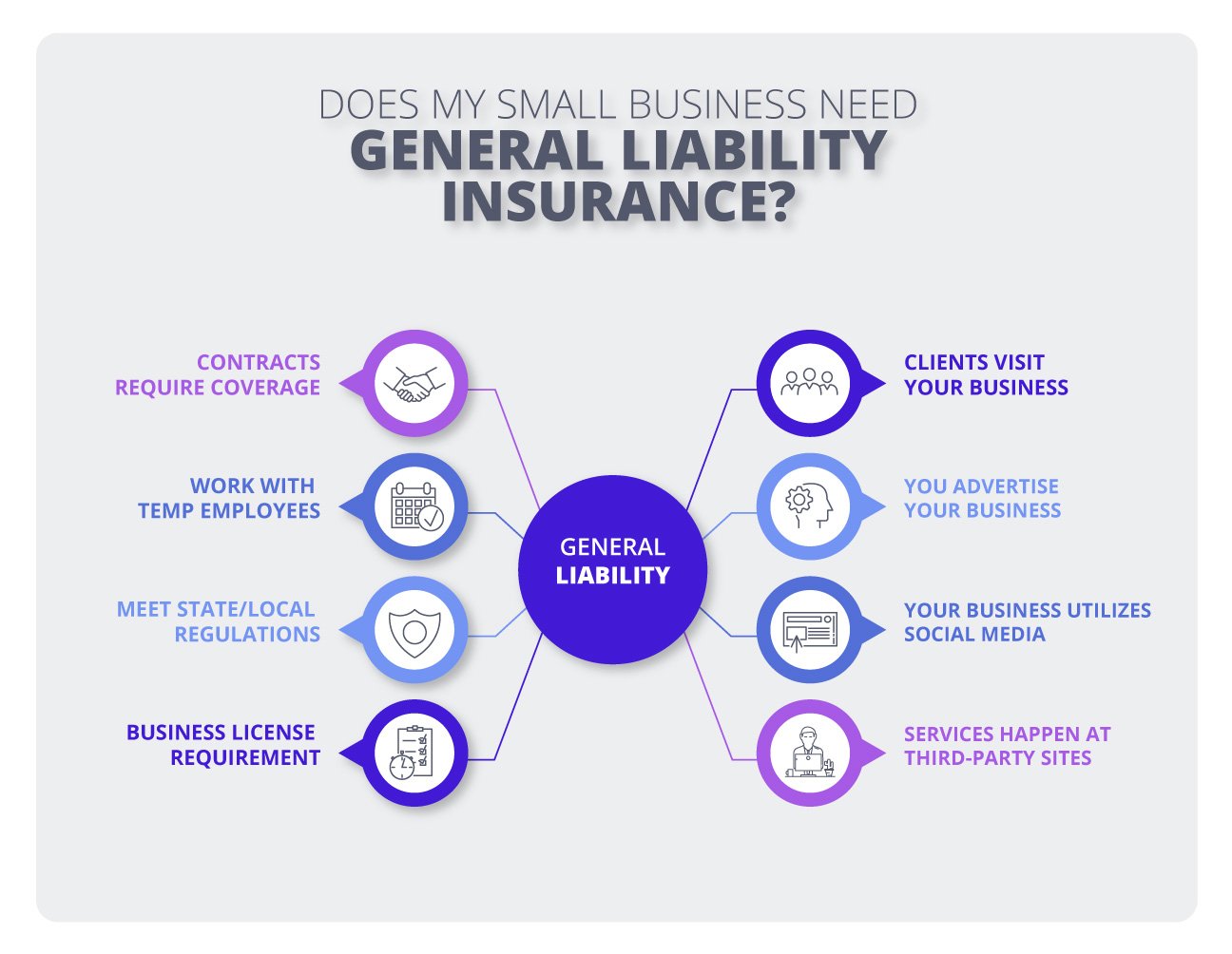
Generally not, but states may mandate it for certain industries like construction. Depending on your type of business, you may need liability coverage to get a license or a permit for your work.
Your business may need to show an ACORD certificate of insurance as proof of your general liability insurance coverage. This document verifies that your business can handle any injury or property damage lawsuits.
General contractors, plumbers, electricians, HVAC installers, and other tradespeople often need general liability insurance to get licensed in their state. You might also need it to get a building permit or other type of permit in your local jurisdiction.
Landlords and lenders often require general liability insurance, so they know they're covered in the event of an accident or lawsuit. You'll likely need to show proof of coverage before you sign a lease or get a business loan.
Your clients might require you to carry general liability insurance, often in a specific amount. You may need this coverage before they'll allow your workers on their property.
General liability insurance gives your clients peace of mind since they know they're protected in the event of an injury or a lawsuit. Clients often prefer to work with companies who are insured, so having coverage can give you an edge over the competition.
General liability insurance is not usually required by law, but business owners should be aware of situations when a licensing body, a client, or a lessor might require this common type of coverage.
While general liability insurance is essential for most small businesses, it does not provide all the protection you need. You'll likely need to invest in additional insurance products to protect against out-of-pocket costs from other kinds of risks.
For instance, your policy does not include coverage for:

Commercial property insurance covers theft, fires, storms, and other incidents that damage or destroy business property. If you own a building with commercial and residential spaces, you may need mixed-use property insurance, which provides important property and general liability coverage for dual-occupancy properties.
Businesses that don't own or rent a building can protect their property with a business personal property (BPP) endorsement on their general liability policy instead.
Personal auto insurance policies almost always exclude business use, outside of your commute.
Most states require that vehicles owned by a business have commercial auto insurance. The amount of auto liability insurance you need also depends on state laws.
Personal, leased, and rented vehicles used for work purposes can be covered by hired and non-owned auto insurance (HNOA), which you can add to a general liability policy.
Employment practices liability insurance (EPLI) covers legal expenses related to harassment, discrimination, wrongful termination, and other violations of employee rights.
Liquor liability insurance covers legal fees from incidents involving people who became intoxicated at your business. That could include drunk driving, assault, and vandalism.
This policy is often required for businesses that sell or serve alcohol, such as restaurants and bars. You can buy it as a standalone policy or add it to your general liability policy.
Hey there! Yeah, up here in the corner. Good news: You've purchased your policy to protect your business! But that's only the beginning...
A licensed expert will email you a certificate of insurance the day you buy a policy. I'd do it, but, you know, I'm an animated talking head.
The certificate means peace of mind. And you can access it on the Insureon online customer portal where you can review policy info and all of your insurance documentation.
Need additional assistance? Or want to make changes? Yeah, no problem! Call toll free, or reach out to a dedicated account manager with questions about billing and claims.
We're with you now, and as you grow. Behind the scenes, but there when you need us. Insureon. Protection is peace of mind.
Traditional insurance agents can take weeks to send a certificate of insurance to new customers, which could be an issue for a policyholder who has a pending contract or lease.
With Insureon, you can usually get proof of insurance the same day you apply for quotes. You’ll need to provide basic information about your business, such as:



Review answers to frequently asked questions about general liability insurance coverage.
Any business type—including limited liability companies (LLCs), sole proprietorships, and home-based businesses—can be held liable and sued for customer injuries, property damage, or advertising injuries. That even includes independent contractors and subcontractors.
If you don’t want to purchase a commercial general liability (CGL) policy, you can ask your clients to add you to their policies as an additional insured. This will protect you for as long as you work for the client who insures you.
In addition to carrying general liability coverage for themselves, contractors sometimes must buy owners and contractors protective (OCP) liability insurance to protect project owners and win contracts.
Most small business owners choose general liability policy limits of $1 million per occurrence / $2 million aggregate (also called general aggregate). This means the policy will pay up to $1 million to cover a single incident, with a $2 million limit on all claims during the policy period, typically one year.
Ninety-one percent of our customers choose a policy with these limits, while five percent choose a policy with $2 million / $4 million limits.
If your business has high risks or a contractual requirement for higher limits, you can boost your coverage with commercial umbrella insurance. Umbrella insurance increases your maximum policy limits, so your insurance company can cover more expensive claims.
Ideally, aim for coverage that's affordable and matches your business needs. You'll want enough coverage to pay for a lawsuit if you're sued. Consider the size of your business and frequency of customer interactions to determine your exposures and risk of financial loss.
General liability insurance and professional liability insurance are two different policies that cover different kinds of lawsuits.
Professional liability insurance is sometimes required by law for real estate agents, insurance agents, and physicians. Depending on the industry, you might see it referred to as errors and omissions insurance (E&O) or malpractice insurance.
Small business owners often invest in both types of business insurance for a comprehensive risk management plan. You may be able to add professional liability insurance to your general liability policy or business owner's policy, depending on your profession.
A business owner's policy, or BOP, is a package that includes both general liability coverage and commercial property insurance. It's often less expensive than buying these policies separately.
The property insurance included in a BOP covers theft, fires, storms, and other incidents that damage or destroy business property. Businesses that don't own or rent a building can protect their property with a business personal property endorsement on their general liability policy instead.
Small businesses with low risks are often eligible for a business owner's policy. For small and midsized businesses with moderate risks, there's the option of a commercial package policy (CPP).
Both BOPs and CPPs often include business interruption insurance, also called business income coverage, which covers lost profits and other financial losses tied to a temporary closure. You can often include other coverage options as well.
No, general liability insurance only covers injuries that happen to people outside your business (third parties).
Workers' compensation insurance covers medical bills and disability benefits for employees who are injured on the job. It's required in most states for businesses that have employees.
Even sole proprietors can benefit from workers' comp, as personal health insurance may deny claims for injuries related to your job.
There are three liability categories included in a general liability policy:
General liability insurance has several exclusions. It won't cover intentional injuries or property damage—which can be criminal offenses—along with willful negligence.
While a general liability policy typically covers damage to someone else’s property, that doesn't include items in your care, custody, and control. You can fill this gap with bailee coverage, which is a type of inland marine insurance.
Other common exclusions include:
To fill gaps in coverage, you can often add endorsements to your policy.
You can find additional information in our frequently asked questions about general liability insurance.
If you have any other questions about coverage, you can contact an Insureon agent.
Obtén más información sobre el seguro de responsabilidad civil general (en español).