


Inland marine insurance

Inland marine insurance
Inland marine insurance provides coverage for business property, such as products, tools, and equipment, while it’s in transit over land or stored at an off-site location.
What is inland marine insurance?
Inland marine insurance is a type of property insurance designed for movable items and specialized assets that may be excluded by other policies. If your items are stolen, damaged, or destroyed, inland marine insurance provides financial reimbursement for the loss.
Inland marine is a "floater" policy, which simply means the coverage goes where the insured property goes. A small business that ships valuables, transports tools, or owns a truck with specialized equipment may need this policy.
You might also see inland marine insurance referred to as tools and equipment insurance.
Why is inland marine insurance important?
Commercial property insurance only covers business property at the location listed on the policy. Inland marine insurance protects against property damage and theft outside your place of business.
For example, if a fire destroys the contents of a business's storage unit, standard property insurance would not provide coverage. You'd need inland marine coverage in order to get reimbursed for the lost items.
In addition, inland marine insurance can cover valuable or specialized assets that may be excluded by commercial property insurance.
Businesses that own custom equipment, transport goods, attend trade shows, or use tools off-site absolutely need this type of insurance, especially with cargo theft at an all-time high. Otherwise, you could end up paying for any losses out of pocket.

Inland marine protects property on the go from a variety of perils:
- Theft
- Fire
- Wind and hail
- Burst pipes
- Vandalism

What does inland marine insurance cover?
Inland marine insurance provides coverage for business property that's transported over land or stored off-site. It can also cover items that are excluded on other commercial insurance policies.
Specifically, your inland marine policy provides protection for:

Property in transit
Commercial inland marine insurance protects business property in transit over land, which is typically excluded from commercial property insurance.
For example, leaf blowers and lawn mowers brought to jobsites by a landscaping company would be covered by inland marine insurance, but not by a commercial property policy.
Another type of inland marine insurance, cargo insurance, covers goods transported by trucking companies.
Property in your temporary care
Some forms of inland marine insurance cover property that's temporarily in your care, but owned by someone outside your business:
- Bailee insurance, or bailee's customer insurance, covers items that are owned by customers but entrusted to your business. That includes everything from customer laptops at a computer repair shop to dogs at a pet boarding facility (animal bailee coverage).
- Garage keepers insurance covers customer vehicles stored at your business, such as a car brought to an auto shop for repairs.
General liability insurance typically covers accidental damage to customer property, but it excludes items in your care, custody, or control.
Property in a fixed but movable location
Inland marine insurance covers business property that's in a fixed but movable location, such as heavy equipment installed inside a van or truck.
For example, inland marine insurance would cover a pressure washing system mounted in the bed of a pickup truck, a bucket lift on a tree trimming company's truck, and a kitchen installed in a food truck.
Property stored off-site
If your business stores property in a warehouse, storage unit, or other location outside of your primary location, you'll need inland marine insurance.
For example, you might need inland marine coverage for vending machines at a client's site, or inventory at a storage unit rented by an online retailer.
Unique or valuable items
Your business may have collectibles, fine art, and other high-value items that can be hard to insure with standard policies.
In this case, you could add inland marine insurance to your commercial property insurance to cover these items. If artwork is stolen or damaged in a fire, the policy would cover the costs.
Property that transfers information
Inland marine insurance can cover property that transfers information, such as laptops, networking equipment, and PCs that travel from place to place.
You may also need electronic data processing insurance for loss of data tied to a property claim.
How much does inland marine insurance cost?

Inland marine insurance costs an average of $48 per month for Insureon's small business customers. Annual premiums range from around $150 to over $4,500 per year.
The cost of inland marine insurance depends on the value of the insured property. It costs more for scheduled items, which are high-value items listed separately on the policy.
Other factors will also affect your premium, such as your business's claims history, location, and industry.
What factors impact the cost of inland marine insurance?
Underwriters consider several factors when calculating the cost of inland marine insurance, such as:
- Type of coverage. You can insure items for their replacement value (the value of a new item) or their actual cash value (the value of the used item).
- Coverage limits and deductible. You can save money on inland marine insurance by choosing lower limits or a higher deductible, but make sure you have sufficient coverage for a potential claim.
- Type of property and its value. The value of the insured property will determine how much you pay for coverage, as you'll need sufficient limits to cover a potential loss. Delicate or specialized equipment may cost more to insure.
- Location. Regional factors such as crime rates, property values, and the risk of severe weather will affect your insurance rates.
- Claims history. A business with a clean history of claims may see lower insurance rates than a company that has filed a claim on their policy.
- Your industry risks. Insurers use your industry to judge the risks you'll likely face. Businesses in industries that move expensive inventory or equipment every day can expect higher costs.
Because these factors vary widely among small businesses, there's a wide range of pricing as well. Our licensed agents can help you find cost-saving bundles and the best insurance solutions for your business needs.
Verified business insurance reviews
Hear from customers like you who purchased small business insurance.
Who needs inland marine insurance?
Inland marine insurance is a specialized form of property insurance, so not everyone needs it.
You may need inland marine coverage if your business does any of the following:
- Frequently ships property by land
- Occasionally ships high-value property
- Brings tools and equipment to jobsites
- Stores property at off-site locations
- Owns a vehicle with equipment installed inside it
Several professions rely on inland marine coverage more often than others, including:

Construction and contracting businesses
Contractors who work in the construction industry usually carry a variety of tools and equipment with them in order to do their jobs. Contractor's tools and equipment insurance protects these tools when you're working at different locations.
For instance, a carpenter may want to purchase tools and equipment insurance to protect saws, hammers, and other items they bring to jobsites.

Videographers and photographers
Videographers and photographers often have specialized equipment that moves from place to place and may be susceptible to damage. An inland marine policy would protect this equipment while it's in transit or at a shooting location.
For example, a video production studio's inland marine policy would cover valuable cameras, lighting, and other equipment that moves to different filming locations in the company's van.

Cleaning businesses
Cleaning businesses routinely handle customer property in their day-to-day work. Because the items are in their care, coverage for broken items is excluded by general liability insurance.
Bailee insurance, a form of inland marine insurance, protects against any damage that happens as a result of your business's house cleaning, window cleaning, or other cleaning operations.

IT professionals
IT professionals depend on computers and other equipment to complete their work. Inland marine coverage protects the policyholder's electronic devices no matter where they go.
For example, employees at an IT consulting firm might bring laptops to clients' homes and offices. To provide protection at off-site locations, the consulting company invests in inland marine insurance.

Bar and café owners
Many bars and cafes exhibit artwork created by local artists. These businesses do not own the items, but they are temporarily in their care—which excludes them from standard property insurance coverage.
Bars and cafes need bailee coverage to cover damage or theft of paintings, sculptures, and other artwork on display at their business.
Top professions that need inland marine insurance


























Get inland marine insurance coverage for your small business
We're on top of your small and medium-sized business insurance needs. We'll help you find policies that protect what you've worked so hard to build.
Start here. Tell us about yourself. Questions? We've got your back. The info you share is secure. We'll double-check it and a pro with experience in your field will be in touch.
Fast? You can compare quotes from leading insurance providers in seconds and get a certificate of insurance the same day.
Always online, always on your side. Helping protect your business.
It's easy to buy inland marine insurance with Insureon. In fact, it can usually be added to your business owner's policy (BOP). Fill out our free online application to get quotes from top-rated providers.
When you purchase a policy, you’ll get a certificate of insurance as proof of insurance for your small business.
What does inland marine insurance not cover?
While inland marine insurance is important for a wide variety of small businesses, it does not cover every risk.
Your policy does not include coverage for:

Vehicles
Commercial auto insurance covers financial losses if a vehicle owned by your company gets into an accident, with an option to add physical damage coverage for collisions and other incidents. It's required in almost every state for business-owned vehicles.
You might also need a mobile equipment endorsement for forklifts and other machinery driven on public roads, or hired and non-owned auto insurance (HNOA) to cover personal, rented, and leased vehicles used for business.
Policy exclusions
An open perils policy, also called an all-risk policy, covers all types of perils unless otherwise stated. Usually, it includes a list of exclusions the policy won't cover.
Open perils policies typically cover fires, windstorms, natural disasters, and theft. Make sure to read the exclusions carefully so you know exactly what's covered.
Items not listed in the policy
A named perils policy only covers events listed in the policy and nothing else. Because its coverage is more limited, it usually costs less than an open perils policy.


General liability insurance

Commercial property insurance

Business owner’s policy

Workers’ compensation insurance

Cyber insurance
FAQs about inland marine insurance
Review answers to frequently asked questions about inland marine insurance coverage.
Why is it called "inland marine" insurance?
This policy is called inland marine insurance because it's an offshoot of ocean marine insurance, which protects property transported over water. Marine insurance came first—hence the distinction "inland" marine for land transportation coverage.
Is contractor's tool and equipment coverage the same as inland marine insurance?
Yes, contractor's tools and equipment insurance refers to the same policy as inland marine insurance. You might also see it called equipment floater insurance or contractor's equipment insurance.
In particular, this term is common in the construction and installation industries. It covers mobile tools and equipment brought to worksites by general contractors, electricians, HVAC installers, and other contractors.
In this category, you can buy miscellaneous tools and equipment coverage for equipment valued under $2,500, or scheduled equipment coverage for items over that amount.
What are the other types of inland marine insurance?
There are several types of inland marine coverage, each providing its own specific protection. That includes:
- Installation floater insurance covers materials and appliances being transported, stored, or installed at a jobsite, such as copper wire awaiting installation at a construction site. Installation contractors often need this policy.
- Bailee insurance coverage protects property that belongs to someone else while it's in your care. Technicians and businesses that repair customer property usually need this coverage.
- Motor truck cargo insurance covers goods in transit while they’re in the care of a trucking company.
What's the difference between property and liability insurance?
Property insurance and liability insurance both protect small businesses against common financial threats. For a strong risk management strategy, you'll likely need both types of coverage.
- Property insurance focuses on your physical assets, and can replace items that are stolen, damaged, or destroyed.
- Liability insurance, on the other hand, protects against legal defense costs if a customer, client, or employee sues your business.
Just as there are several types of property insurance, different liability policies protect against different types of lawsuits. If you're unsure which coverage you need, our licensed insurance agents can help.
How do you buy inland marine insurance?
Small business owners can often add inland marine insurance to another property insurance policy, such as a business owner’s policy or a commercial package policy (CPP). Bundling insurance products usually costs less than purchasing each policy separately.
A BOP includes both general liability insurance and commercial property coverage, protecting your business against the most common risks faced by small businesses. A CPP is similar to a BOP, but it has more flexible coverage options and it's generally purchased by small or midsized businesses with higher risks.
To compare quotes from top-rated U.S. insurance companies for a business owner’s policy or commercial package policy, fill out Insureon’s free online application.
What are the common characteristics of inland marine insurance forms?
Insurance companies use different forms for their inland marine insurance policies, but the forms will look similar. You can expect it to include:
- The type of inland marine insurance purchased
- Named perils covered by your policy, such as fires and windstorms
- Exclusions, such as damages related to war or civil unrest
- Your policy limits and deductible
- A coinsurance clause affirming that the limits are appropriate for the value of the insured property
Is inland marine insurance the same as builder's risk insurance?
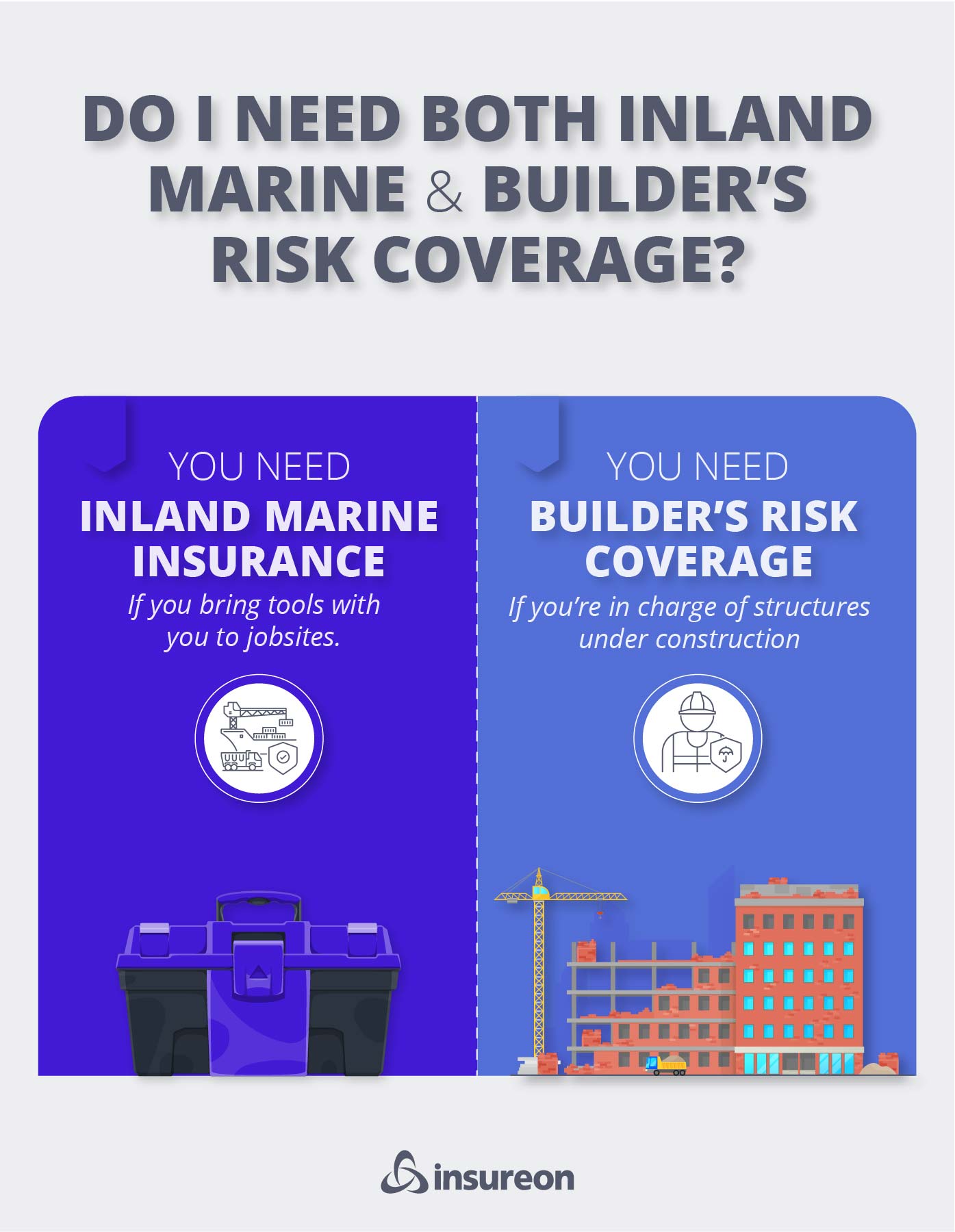
Builder's risk insurance is a type of inland marine coverage that protects equipment and building materials during a specific construction project, along with the structure in progress.
Inland marine insurance is a broader category that encompasses several different kinds of property insurance that go above and beyond your standard commercial property insurance.
Unlike a standard commercial property policy, inland marine policies protect your business property at locations other than your business address. You may need them for certain kinds of property, such as valuable artwork, or for items that you are taking care of for a customer.
Learn more about the difference between inland marine and builder's risk insurance.