




























Find workers' comp insurance quotes
Save money by comparing insurance quotes from multiple carriers.

When contractors take on a project, they should secure workers' comp for themselves and anyone else involved to protect against costly medical bills and lost wages from an injury.
Physical labor brings a high risk of injuries, which can lead to expensive treatments or a prolonged period when you're unable to work. If you're injured on the job, workers' compensation covers your medical bills and provides disability benefits to offset the wages you'd otherwise lose.
For instance, a handyman might suffer a back injury caused by crouching under sinks and other hard-to-reach places. A workers' compensation policy would pay for their doctor appointments, medications, physical therapy, and other expenses. If the injury impacts their ability to work, then they'd receive workers' compensation benefits as well.
Workers' compensation is mandatory in most states for employees. Contractors can often buy workers' comp coverage for themselves—and in some cases, it's required.
Most workers' comp policies include employer’s liability insurance, which covers an employer's legal costs if they're sued over a work-related injury.
Workers' compensation insurance is a no-fault policy, which means it provides coverage for an employee who is injured on the job no matter who is to blame.
In the event of an employee injury, workers' comp pays for all medical expenses related to the incident, from an ambulance ride to long-term physical therapy. It can also pay for retraining if the employee is unable to return to their prior job, or death benefits for fatal incidents.
Unlike other insurance policies, there's no cap on workers' comp limits for medical care and benefits beyond those dictated by state law. However, the employer's liability portion of workers' comp does have limits on a claim.
When an employee is injured, you should start the process of filing a claim as soon as possible to meet state deadlines and ensure prompt payment. Typically, employers must report workers' comp claims to their insurance carrier within seven days.
Sole proprietors should consider investing in workers' comp to protect themselves financially. Health insurance does not cover injuries related to work, which is why you should consider buying coverage for yourself.
Contractors who are self-employed may need to show proof of workers' comp in order to sign contracts with clients, even when coverage isn't required by law. In this case, they can sometimes buy an inexpensive ghost policy or other type of minimum premium policy, which can fulfill contractual requirements without actually providing coverage.
Though independent contractors aren't always eligible for workers' comp, it's often a wise investment for them. The high cost of medical care and the possibility of being out of work due to an injury make coverage worthwhile for everyone who qualifies.
Finally, if you hire employees or subcontractors, the employer's liability insurance included in workers' comp can provide crucial protection against legal costs if a worker blames your business for their injury.

Every state has its own workers' compensation laws, so whether you're legally required to have workers' comp depends on where you work. The number of employees, type of work, and business structure (such as LLC, partnership, or 1099 employee) can all impact state requirements.
In most states, contractors must provide workers' compensation for their employees, including full-time, part-time, and seasonal workers. In other states, you'll need workers' comp in order to get a contractor's license.
Here's a quick breakdown of the laws in a few states:
States often have stricter requirements for contractors in the construction industry due to the high risk of injury. Roofing contractors in particular are sometimes required to buy workers' comp coverage, regardless of whether or not they have employees.
Even when contractors qualify for an exemption, they may choose to purchase workers' compensation coverage for the financial protection it offers.

Whether subcontractors and their employees are required to have workers' comp depends on the specific laws in your state and the terms of your contracts.
For example, construction contractors in Florida must ensure that subcontractors have the necessary workers' comp for their employees before work begins on a project. If the subcontractor does not have workers' comp, then these workers are considered employees of the contractor, who assumes financial responsibility for any injuries.
Basically, you want to make sure that your subcontractors are covered—either with their own policy, or yours. Otherwise, you could end up responsible for medical bills and disability benefits if an injury occurs during the project.
There are four monopolistic states where workers' comp must be purchased through the state fund instead of private carriers:
Employer’s liability insurance usually isn't included in workers' comp policies bought from state funds. However, you can purchase it as stop gap coverage from a private insurance company to protect your business from legal costs related to employee injuries.

A contractor who takes on small residential projects with a couple of employees won't have to pay a lot for workers' comp.
Workers' comp for contractors costs an average of $160 per month, or $1,916 annually. You could pay more or less depending on the size of your business.
Underwriters will look at several factors when determining insurance costs for contractors, including the type of work you do and your annual revenue.
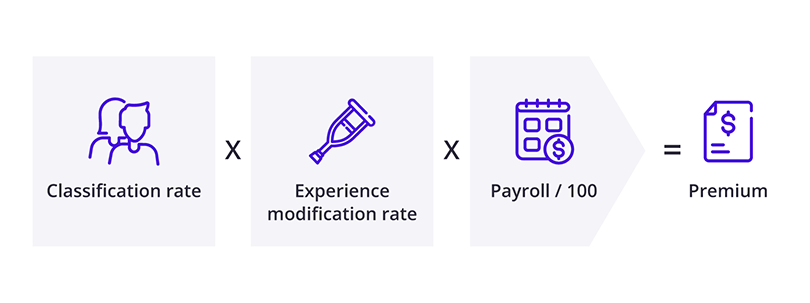
The amount you pay for workers' compensation insurance is a specific rate based on every $100 of your business's payroll. Insurers will calculate your premium by evaluating the type of work done by your employees (classification rate), your experience modification rating (claims history), and your payroll (per $100).
The formula providers use in underwriting to calculate workers' comp rates is: Classification rate x Experience modification rate x (Annual payroll / $100).
Insurance providers will consider a number of factors when calculating your workers' comp premiums, including:
It's easy to find affordable workers' comp insurance with Insureon. Our easy online application lets you compare quotes from trusted insurance companies to find policies that fit your budget and your unique risks.
Other ways for contractors to save money on workers' comp include:
Insureon's licensed agents can help you find the right workers' comp policy for your business, whether you work as a sole proprietor, an independent contractor, or you hire employees or subcontractors.
Workers' compensation provides crucial protection against workplace injuries, but it doesn't cover every risk. Contractors should also consider:
Contractors choose Insureon as a way to compare quotes in one place, get expert help, and manage their coverage online. You can fill out our easy online application to get quotes for workers' compensation and other policies from top-rated insurance companies.
Our licensed insurance agents can help you find the right workers' comp policy for your business needs. Once you select a policy, you can begin coverage and get a certificate of insurance (COI) in less than 24 hours.
The average costs on this page were derived from our data on small business owners in the contracting field who purchased policies through Insureon. Most of our customers have less than five employees, annual revenue ranging from around $50,000 to more than $200,000, and five years or less in business.



By entering your email address and subscribing, you agree to our Terms of Use and Privacy Policy