




























Find errors and omissions insurance quotes
Save money by comparing insurance quotes from multiple carriers.


Errors and omissions insurance (E&O) helps cover the cost of a lawsuit if a client claims your work was inaccurate, late, or never delivered. It’s sometimes called professional liability insurance.
Errors and omissions (E&O) insurance—also known as professional liability insurance, professional indemnity insurance, or malpractice insurance—helps protect your business if a client claims your work caused them financial harm due to a mistake, oversight, or professional negligence.
Even small, unintentional issues, like a missed deadline, incorrect advice, or a simple miscommunication, can lead to costly lawsuits. E&O insurance can help cover legal defense costs, settlements, or judgments, so one claim doesn’t put your business at risk.
For small business owners and independent professionals, E&O coverage provides peace of mind that you’re protected when things don’t go as planned, especially when your expertise or services are central to your work.
Mistakes can happen in any business—but when your work involves providing professional advice or services, even a small issue can lead to a costly claim. Errors and omissions insurance helps ensure that one unhappy client doesn’t turn into a major financial setback.
Many small businesses need this coverage to operate. Your clients may require proof of E&O insurance before signing a contract, and certain professions need it to meet licensing requirements.

Most E&O claims and lawsuits are straightforward, such as failure to deliver a service as promised. However, others are more complicated.
When a client hires you to provide a specialized skill, they’re entitled to a reasonable standard of care. If a client is harmed because you failed to meet this standard, then your business could face a lawsuit.
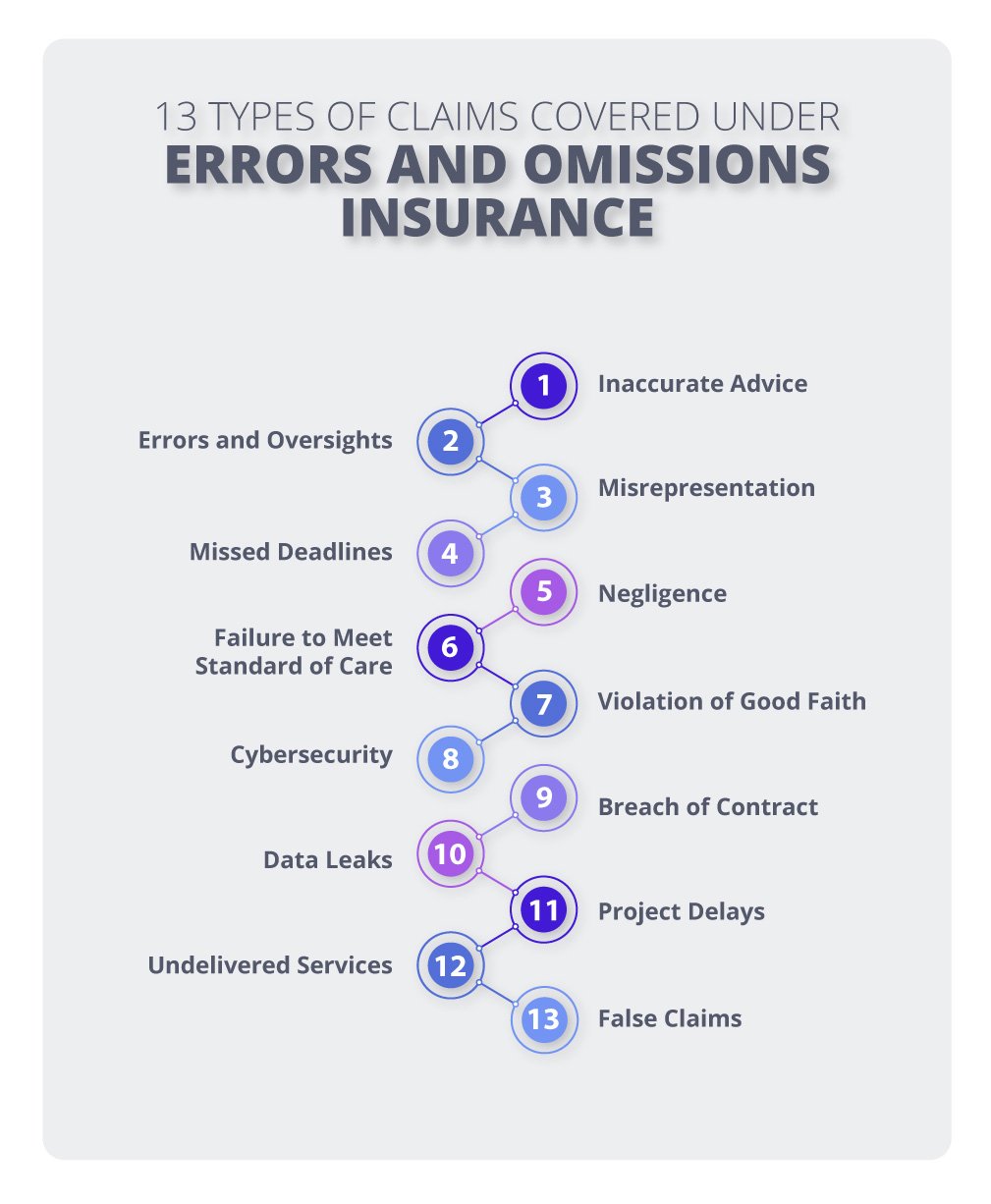
Specifically, errors and omissions insurance covers a wide range of claims, including the following:

Even a small error or oversight in your work could end up costing a client money. When the client tries to recoup their losses by suing your business, errors and omissions insurance helps pay for attorney's fees and other legal costs.
If your business leaves work unfinished, it can interrupt your client’s business plans. When you fail to deliver promised services, a client could sue—especially if it negatively impacts the client’s bottom line.
If your business misses a deadline, it could delay your client’s project and result in lost revenue. If a client sues your business over late work, errors and omissions insurance can cover the cost of the lawsuit, including attorney fees.
A client could accuse you or one of your employees of breaching a contract by failing to provide an agreed-upon service. Depending on the severity of the breach, this could potentially result in a lawsuit. E&O insurance would protect your business from an accusation of a breach of contract.
If a client accuses you of making a false statement to secure a contract, such as exaggerating your level of experience or knowledge of a subject, the client could sue you for misrepresentation. If a buyer thinks a Realtor falsely described the conditions of a building or a neighborhood, they might seek compensation in court.
If a client's expectations don't align with the services you deliver, then the result could be a lawsuit. To avoid misunderstandings, it helps to outline your company's services and expected outcomes in an agreement or contract that's shared with the client.

The average cost of errors and omissions insurance is $88 per month. Insureon's customers pay less than $75 per month for this coverage, though annual premiums typically range from around $400 to over $7,000 per year.
The majority of Insureon's customers (56%) choose E&O policies with limits of:
Your premium depends on the limits and deductible you choose, among other factors.
The cost of errors and omissions (E&O) insurance depends on several factors related to your business, your work, and your risk level. Understanding these can help you find the right coverage at the best price.
Key factors that influence your insurance premium include:
For many small businesses, E&O insurance is more affordable than expected. About 46% of Insureon customers pay less than $75 per month, and 28% pay between $75 and $150 per month for their policies.
Errors and omissions insurance offers protection across a wide range of industries that provide professional services or advice to their clients and customers. It's designed for both businesses and independent contractors that make a living off of their expertise.
Some professionals may need this coverage to work for a certain client or to comply with state laws. Industries that often require E&O coverage include:

IT professionals typically buy technology errors and omissions insurance, or tech E&O, which includes both E&O insurance and cyber insurance. This bundle protects against lawsuits related to contract disputes, coding errors, and data breaches.
For instance, a client hires an IT consultant to protect their customer data, but a data breach exposes the names and credit card details of thousands of customers. The client believes the IT consultant should have been able to prevent the incident and files a negligence lawsuit. In this case, tech E&O would pay for the consultant's legal costs.
Tech E&O is essential for those who work in cybersecurity or recommend software to their clients. Some clients will only work with tech companies that can prove they have an active E&O insurance policy, even if they have cyber insurance.

E&O coverage for insurance agents can protect against an oversight that leaves a client vulnerable to liabilities. It also covers bad advice that led to inadequate coverage. Some clients may require proof of E&O insurance before they agree to work with you. It's also required in some states, depending on the type of work you do.
For example, an insurance agent fails to obtain adequate auto insurance coverage for a client, despite promising to do so. When the client gets in an accident and goes to make a claim, they’re surprised to find themselves uninsured. They sue the insurance agent for failing to secure the appropriate coverage.

Some states require E&O for real estate agents and brokers. This policy helps pay for lawsuits over failure to close, mismanagement, disclosure errors, and other professional issues. Unless you show proof of E&O insurance, some clients, buyers, or sellers may refuse to work with you.
For instance, a real estate agent makes an error on an MLS sheet, incorrectly listing a home’s square footage as more than it is. The homebuyer realizes the error after purchasing the home and sues the agent. The real estate agent’s E&O policy covers the court costs and the eventual court-ordered judgment.
To avoid E&O lawsuits, make sure to treat all clients fairly, document your communications, and describe properties accurately.

Many professionals, such as notaries, travel agents, and recruiters, make their living by advising others based on their industry knowledge and expertise. A mistake, such as poor advice or a miscalculation, can have negative consequences for clients, which can lead to a lawsuit.
Errors and omissions insurance can support professional service providers in the event that a client is unhappy with the services provided.

E&O insurance for tax preparers covers the costs of lawsuits over missed deadlines, accounting errors, or lost documentation. This policy offers indirect protection for the client if there’s a mistake in their taxes. That’s why some clients will ask for proof of insurance before they’ll use your financial services.
For example, a tax preparer fails to file a client’s tax return before the deadline and now the client is forced to pay a costly fine. To recoup the fine, the client sues the tax preparer for missing the filing deadline.
Start by completing Insureon’s easy online insurance application to compare free quotes from top-rated insurance companies. If your business qualifies, you can choose a policy and get covered—often in just a few minutes. Insureon's expert insurance agents can help you choose the best errors and omissions coverage for your business's needs.
Most small businesses that provide services for a fee can get E&O insurance, as long as they meet basic underwriting requirements, such as:
Once you’re eligible, you can purchase coverage and typically receive your errors and omissions insurance certificate the same day.
This certificate serves as proof of insurance and can be shared with clients who require coverage before signing a contract or starting a project.

While errors and omissions insurance covers many aspects related to legal action from a client, it does have a number of coverage exclusions. For example, it only covers the cost of defending against lawsuits—it doesn't pay for lawsuits you initiate. Mistakes that are made intentionally are also not covered.
Unless your policy has prior acts coverage, it will only cover E&O claims filed while the policy is active and for incidents that occurred after you bought the policy. In this case, endorsements can fill gaps in your errors and omissions coverage.
Other exclusions from errors and omissions insurance coverage include:

If you accidentally damage a client’s property or a client is injured at your office, general liability insurance will help pay for the client’s property repairs or medical care. This policy can also cover your legal expenses if the client sues.
If an employee suffers a work-related injury or illness, workers' compensation insurance can cover their medical expenses and provide disability benefits while they are recovering.
If a job candidate or employee sues your business for harassment, discrimination, or wrongful termination, then employment practices liability insurance (EPLI) can cover the cost of your legal fees, as well as the cost of a settlement or judgment.
E&O insurance will not provide coverage for activities that were illegal or purposefully caused harm. Intentional wrongdoings generally do not fall under the umbrella of what insurance will cover.
If your business property is damaged, destroyed, stolen, or lost, then a commercial property insurance policy can pay to repair or replace the affected items.
Most states require commercial auto insurance for vehicles owned by a business. If your business uses personal, rented, or leased vehicles, you'll need to purchase hired and non-owned auto insurance (HNOA) instead.
Product liability insurance covers costs if a product made, sold, or distributed by your business injures a customer or damages their property. It's usually included in general liability insurance.



When it comes to your small business, its success stems from your expertise, fulfilled contracts and happy clients. But what if a client is unsatisfied with the outcome you delivered? This is where a policy like errors and omissions can help.
So, what is errors and omissions insurance? Also known as professional liability insurance, E&O helps protect your business from lawsuits filed by unsatisfied clients.
This coverage applies to work mistakes and oversights, undelivered services, missed deadlines, and accusations of negligence.
Based on several factors including risk, business size, and claims history, the cost of E&O coverage can vary from business to business.
Get free errors and omissions insurance quotes from Insureon today. Click the link to get started.
Review answers to common questions about E&O insurance.
Errors and omissions insurance isn’t always required by law, but in some cases, you may need it to operate your business or work with clients.
Here are the most common situations where E&O coverage may be required:
Even when it’s not legally required, E&O insurance is often considered an essential part of risk management. It helps protect your business from the financial impact of claims related to your work, making it a smart safeguard for many small business owners.
If you work for yourself, E&O insurance can be an important safeguard for your business.
Self-employed professionals—like consultants, freelancers, and some sole proprietors—are still responsible for the advice and services they provide. If a client claims your work caused a financial loss, you could be held personally liable for legal costs and damages.
In many cases, clients will require E&O coverage before agreeing to work with you. This is especially common in fields like IT, marketing, finance, and other professional services.
Even when it’s not mandated, errors & omissions insurance is a smart investment if your work involves high-stakes decisions or financial outcomes. For example, a financial advisor or software developer could face significant claims if a mistake impacts a client’s revenue or operations.
Errors and omissions insurance covers legal defense costs related to accusations that you failed to meet the terms of a contract or were negligent in your work.
If a lawsuit is filed against your business, you’ll need to notify your insurance provider and provide details about the incident to make an errors and omissions claim. Once your claim is approved, your policy can help pay for legal defense costs, settlements, or judgments—up to your coverage limits.
Be aware that errors and omissions insurance is a claims-made policy. That means your policy must be active both at the time of the incident and when the claim is filed in order to benefit from coverage.
That’s where prior acts coverage, sometimes called retroactive coverage, comes in. When you purchase a policy, you may be able to set a retroactive date that covers work you completed in the past, as long as it was after that date. This helps protect you from claims that arise later from earlier projects.
Because of this structure, it’s important to maintain continuous coverage. If your policy lapses, you could lose protection for past work and end up paying out of pocket for claims tied to previous services.
This coverage has a few names, but they all refer to the same policy. Different types of businesses use different terms:
Most small businesses can benefit from carrying both general liability and E&O insurance, as these policies protect against different types of lawsuits.
You can look to a general liability policy for protection against common accidents, such as customer slip-and-fall injuries or accusations of slander. These types of claims can happen at any business.
On the other hand, an errors and omissions insurance policy will cover claims of professional negligence, not bodily injuries. You'll want to consider this coverage if your work could harm a client's finances. It's recommended for businesses that provide professional services or expert advice to clients.
You can find answers to other common questions in our frequently asked questions about E&O insurance.
To get cheap errors and omissions insurance that matches your business's risks and your budget, fill out our easy online application today. A licensed agent can help you choose the best coverage for your small business.