Why construction cost estimating matters for insurance costs and profitability

Learn about our editorial policies


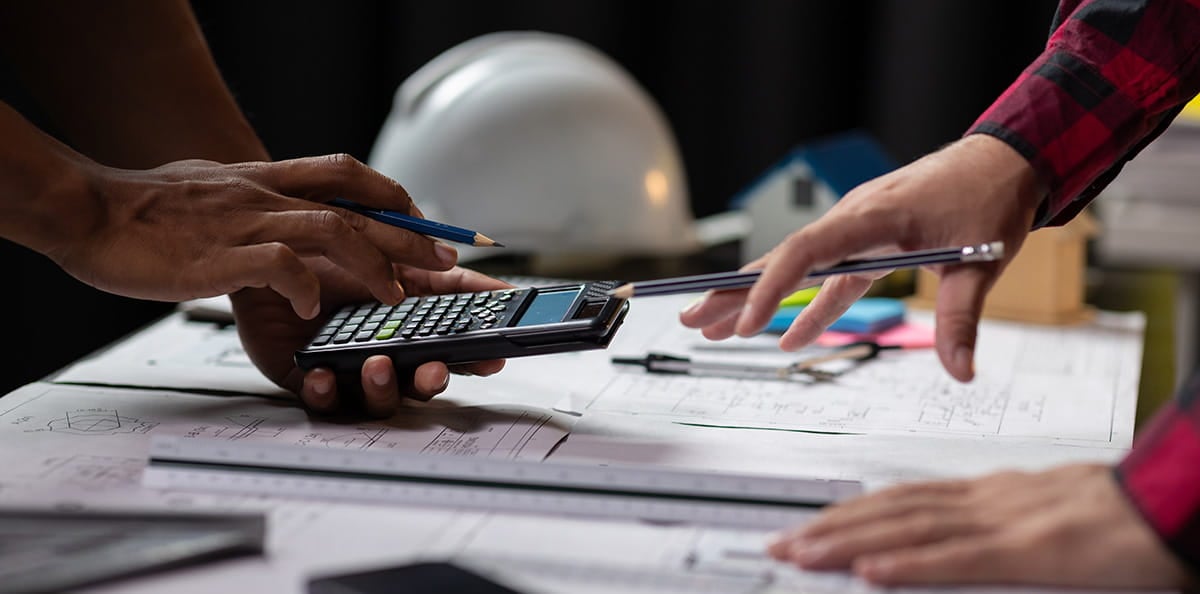
Whether you run a handyman service, painting business, or roofing company, cost estimating in construction is a critical component of completing successful jobs and growing a successful construction company.
Taking the time to accurately estimate the costs for a project can help you avoid issues like:
- Customer disputes and change order conflicts
- Missed deadlines and subcontractor payment issues
- Claims or lawsuits that affect your claims history and future premiums
Properly estimating your bids can boost profitability, earn client trust, meet project deadlines, and reduce your risk exposure.
If you own a small- or mid-sized contracting business, this guide will help you create more accurate estimates, build stronger relationships with customers, and protect your business for the long haul.
- What is construction cost estimating?
- Why accurate construction cost estimating matters beyond the bid
- The main types of construction cost estimates contractors use
- How to estimate the cost of construction step by step
- What is the 0.6 rule for cost estimating?
- Common construction estimating mistakes that can hurt profitability
- Technology and software are changing construction cost estimating
- Best practices for improving construction estimating accuracy
- Protect your business with insurance designed for contractors with Insureon
What is construction cost estimating?
Cost estimating for construction is the process of forecasting what a construction project will cost before work begins. A complete estimate typically includes costs for:
- Materials, labor, and equipment
- Licenses and permits
- Subcontractors
- Insurance costs, overhead, and contingency funds
- Your profit margin
Accurately estimating construction costs helps you submit competitive bids, protect your margins, avoid cash flow gaps, and reduce the likelihood of disputes and claims down the line.
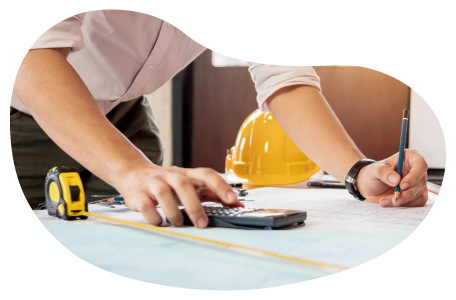
Why accurate construction cost estimating matters beyond the bid
Winning a job is just the beginning—what happens once the project starts depends heavily on the accuracy of your estimate. Here are some of the ways your estimate impacts an entire project:
Poor estimates can create expensive project risks
If your numbers are off in your estimates, problems can quickly build up. If your budget doesn't have any cushion, it's going to be difficult to cover construction material price increases, schedule delays, and other unexpected issues, including:
- Cost overruns that cut into your profit margin
- Project delays that deteriorate client relationships
- Scope-of-work and contractual disputes
- Quality shortcuts that lead to longer-term issues
- Late payments to subcontractors or suppliers
These problems can cause more than a few headaches. They can lead to professional liability claims, expensive breach-of-contract lawsuits, property damage claims, and reputational harm that's hard to recover from in the competitive construction industry.
How construction estimating may affect insurance costs
Insurance costs and accurate construction estimating are more closely linked than many contractors realize. When pricing business insurance coverage, insurance providers will assess a business's overall risk and claims history.
For example, a general contractor with a history of customer disputes, abandoned projects, or repeated claims may be seen as a higher risk, leading to higher premiums, limited coverage options, or additional scrutiny during underwriting.
Although one miscalculated estimate won't affect your insurance rates, having a history of project failures can add to your claims history. And, as your projects grow larger and budgets get bigger, estimating correctly can help you keep premiums down for your key insurance policies.
The most important policies for construction businesses include:
- General liability insurance covers basic business risks, such as accidental damage to a client's property or customer injury, paying medical bills, property repair costs, and legal expenses.
- Tools and equipment insurance, also called inland marine insurance, pays to repair or replace a contractor's tools and equipment if they're lost, stolen, or damaged while in transit or on-site.
- Builder's risk insurance helps pay for damage done to a structure while it's under construction, including fire or vandalism.
- Workers' compensation insurance handles medical costs, disability benefits, and lawsuit expenses arising from work-related employee injuries and illnesses. Most states require workers' comp coverage for businesses with employees, and more states are starting to mandate it for contractors, even if they don't have employees.
- Commercial auto insurance is required by almost every state to cover the cost of accidents involving company-owned vehicles. However, if you or your employees use personal, rented, or leased vehicles for work, you'll need hired and non-owned auto insurance (HNOA), as personal auto insurance won't cover work-related driving.
- Professional liability insurance, also called errors and omissions (E&O) insurance, protects your construction business from lawsuits over the quality of your work or the work of subcontractors you hired.
- Commercial umbrella insurance increases the coverage on your general liability, commercial auto, and employer's liability insurance once a policy limit is reached.
The main types of construction cost estimates contractors use
Construction cost estimates are prepared in four ways, growing more precise as a project evolves, and plans are finalized.
The four types of construction cost estimation are:
Preliminary or conceptual estimates
Preliminary estimates are typically done during the design phase of a project, before plans are finalized. These high-level estimates help determine feasibility, set a rough budget, and secure early funding.
Typically, these early-stage estimates rely on square footage, comparable past projects, or cost data benchmarks. They’re helpful when discussing initial plans and scope with clients, though it’s important to explain that the numbers could fluctuate once plans are finalized.
Unit cost estimates
Unit cost estimating breaks a project down into measurable units:
- Cost per square foot
- Cost per room
- Cost per fixture
This cost-per-unit approach is commonly used for residential construction jobs, where costs for kitchens, bathrooms, or home square footage can be estimated quite accurately.
For example, home renovation businesses that accurately track job costs can provide clients with a more precise budget when discussing a project's scope.
Detailed estimates, sometimes called stick estimating
Detailed estimating provides a line-by-line breakdown of every cost required for a project, including:
- Labor
- Materials
- Equipment
- Subcontractor fees, including insurance coverage
- Permits
- Overhead
Although a thorough estimate takes a substantial amount of time and effort to put together, it's the most accurate way to finalize a bid and set the project up for success.
Assembly or parametric estimates
Instead of itemizing every item, assembly estimating groups costs, like framing, MEP, or finishes. Parametric estimating takes a similar approach but uses statistical models and historical project data to calculate costs.
These methods are typically used during preconstruction, especially for:
- Repeat or system-driven projects, such as building a chain of storefronts or multiple apartment buildings.
- Tight project timelines, if a client needs a budget figure to quickly secure financing, move forward with a design, or evaluate competing bids.
- Design plans that have limited specs, make a detailed estimate difficult to produce.
How to estimate the cost of construction step by step
Knowing how to accurately estimate the cost of construction starts with a detailed process. Here are the steps you need to take to create reliable estimates.
Review project plans and specifications carefully
To get started, you need to review everything tied to the project, including:
- Blueprints and architectural drawings
- Scope documents and project specifications
- Engineering requirements and structural plans
- Written client communications and expectations
Understanding these key details and having all the important construction documents on hand can help you estimate costs more accurately and reduce the chances of a client dispute or misunderstanding later in the project.
Perform a site visit before finalizing numbers
Visiting a project site brings everything into view, showing you exactly what you're working with. Soil quality, existing structures, and other site conditions can affect how a job gets done and what it costs, namely:
- Labor hours needed, such as unusual site conditions
- Equipment requirements
- Excavation challenges
- Delivery logistics for materials and machinery
- Safety protocols to protect workers and visitors
Complete a detailed material takeoff
A material takeoff is the foundation of any properly detailed estimate. You need to calculate the quantity of each material needed for the project, and then price those quantities based on market rates.
To do this correctly, make sure you:
- Review plans thoroughly, including structure, envelope, and finishes
- Account for waste factors, including lumber, tile, and drywall
- Price quantities against current supplier quotes, not historical rates
Estimate labor realistically
Accurately estimating labor costs is a crucial part of the process. Being realistic about the hours and number of workers will help you budget for fluctuations in efficiency and productivity. Factor in:
- Realistic crew size for each project phase
- Productivity rates based on past projects
- Overtime needs for tight deadlines
- Skilled labor shortages, which can slow timelines and increase costs
- Subcontractor pricing volatility, especially during busy seasons
Include overhead, insurance, and operating costs
Every project needs to carry a portion of your operating costs, not just the costs of the work itself. Don’t forget to include:
- Administrative and office expenses
- Vehicle and fleet costs
- Tools and equipment costs, including rental and maintenance
- Insurance premiums
- Licensing
- Surety bonds, if required for a contract
It’s important to calculate these expenses accurately. If your overhead is higher than your markup accounts for, you’re losing money on every job.
Add contingency funds for unexpected costs
Unexpected costs can derail a project, a budget, and your profit margin. Having contingency funds factored into a budget is a crucial part of your risk management plan, keeping you on track and profitable, even if unforeseen costs come up, such as:
- Material price increases
- Supply chain disruptions
- Weather delays
- Change orders
Build in an appropriate profit margin
As the last line in your estimate, the profit margin depends on your market, type of project, and business costs. However, all margins should consider:
- Actual overhead, so you’re not underpricing
- Appropriate margin amounts, as low-margin jobs leave no room for error
- Business reinvestment, equipment needs, and slow seasons
Margins should be treated as a business sustainability tool, not just a line item. It’s important to find a balance between competitive pricing and long-term profitability, to ensure your business is around for the long haul.
What is the 0.6 rule for cost estimating?
The 0.6 rule, or six-tenths rule, is a shortcut commonly used by industrial and commercial builders to scale project costs up or down when you know the cost of a similar project but need to estimate a different size. A building twice the size doesn’t necessarily cost twice as much to construct, which is where this formula comes in:
- Take the ratio of the new project’s size to the known project’s size
- Raise it to the power of 0.6
- Multiply by the known project’s cost
- The result is a rough estimate for the new project
For example, a mechanical contractor installed an HVAC system in a 25,000 square-foot building for $500,000. To get a rough estimate for a 40,000 square-foot building, they can use the six-tenths rule to quickly ballpark the project at about $677,000.
Keep in mind, the 0.6 rule is meant for quick, conceptual estimating. Contractors still need to validate estimates with accurate labor and material pricing for a more realistic budget.

Common construction estimating mistakes that can hurt profitability
Estimating errors can show up at any point in a project, often when there’s limited room to correct. Keep an eye out for these common mistakes:
Underestimating labor costs
Labor costs are the hardest to predict, as issues can derail an entire budget due to:
- Assuming unrealistic productivity rates
- Not accounting for delays caused by weather, inspections, and other workers
- Underestimating rework time if quality issues arise
- Failing to factor in the need for overtime
Forgetting indirect costs
Indirect costs are easy to overlook, but they add up quickly. Failing to factor in these costs can reduce your profit margins, which can include:
- Insurance premiums and bonding costs
- Permits and inspection fees
- Fuel and transportation expenses
- Equipment maintenance and repair
- Administrative costs
Using outdated material pricing
Market costs of materials can fluctuate significantly between the time you bid on a job and the time you need to buy materials. To accurately price materials, make sure you consider:
- Inflation driving up baseline costs
- Tariffs impacting imported materials, such as steel and lumber
- Supply chain disruptions that increase prices or delay delivery
Failing to document assumptions and scope
Scope disputes and change order conflicts are much harder to resolve if you’re not documenting your assumptions. Having clear documentation will help you establish agreed-upon expectations, create a paper trail to refer to if disagreements arise during a project, and reduce the chances of claims or lawsuits over unmet expectations.
Taking on projects outside your experience level
Stepping into projects outside of your expertise can provide growth opportunities, but it’s risky not to account for the learning curve in your estimate. More complex projects and larger budgets can mean:
- More expensive mistakes and rework
- Greater liability exposure
- Potential insurance cost increases
- Operational strain that impacts other projects
Technology and software are changing construction cost estimating
Technological advances have made cost estimating in construction much more accurate, efficient, and easy to complete. Construction software can take on everything from tracking pricing in real-time to handling day-to-day construction management tasks. And now, artificial intelligence (AI) has entered the picture, with many contractors wondering if ChatGPT can do construction estimates.
There are a few spots where AI and software tools can help, and also where they fall short.
How contractors use estimating software today
Cost estimating software has streamlined the bidding process, replacing the hours spent creating Excel spreadsheets with quicker calculations and more accurate cost estimates. You can increase efficiency by leveraging project estimating software to handle:
- Digital quantity takeoffs that calculate quantities based on uploaded plans
- Cost databases with current pricing for materials and labor
- Pricing tools that flag shifting market rates
- AI-assisted forecasting to identify cost trends
Where AI tools like ChatGPT can help
Although ChatGPT, Claude, and other AI tools can’t create a building construction estimate on their own, they can help put together the most important pieces, such as:
- Drafting project scopes based on notes and specs
- Organizing and formatting estimate templates
- Summarizing lengthy project specs
- Identifying missing cost categories
- Writing client-facing estimate details in plain language
Think of ChatGPT and AI as a tool that can help organize and polish an estimate, making your process much quicker and more professional.
Why AI can’t replace contractor expertise
ChatGPT and other AI tools do have limitations. It’s important to understand the parameters of these tools so you can use them to your full advantage. AI tools can’t help with certain tasks, like:
- Inspecting jobsites and assessing conditions on the ground
- Using the most up-to-date figures to price materials and labor
- Knowing all the compliance, licensing, and code requirements
Keep in mind, any errors in an AI-generated estimate are still your liability once you sign a bid, so it’s important to incorporate your knowledge and experience when working with a tool like ChatGPT.
Best practices for improving construction estimating accuracy
Reliable estimates are a result of having a good process and refining it based on past projects. Here are some best practices to follow to improve your estimate quality:
Standardize your estimating process
Following the same structure for every estimate makes it easier to spot gaps, compare bids, and train your project team to help with the process. You can streamline your estimation process by implementing:
- Templates: Pre-built estimate frameworks that cover every relevant cost category will help you avoid pricing each project out from scratch.
- Checklists: Detailed lists confirm every cost category has been accounted for, including labor, materials, insurance, and overhead.
- Cost tracking systems: A consistent method for recording estimated and actual costs for every project will allow historical data to inform future estimates more accurately.
Maintain accurate historical project data
If you carefully track every project, your past jobs will be your strongest estimating tool. After each job, make sure to document:
- Actual labor hours vs. initial estimates
- Total materials used and any overages
- Change orders and what caused them
- Project delays and their cost impact
- Overall profitability by project type
Review insurance requirements before bidding
Insurance costs can add up quickly and should be factored into every estimate. Before you bid, be sure to verify important insurance requirements, such as:
- Contractual insurance needs from the client or general contractor
- Certificate of insurance (COI) requests
- Minimum coverage limits for larger projects, and whether you need umbrella coverage to meet those limits
Revisit estimates regularly during the project lifecycle
Scope changes, increased material costs, and shifting timelines can all occur during a project’s lifecycle, and your estimates should evolve as changes come up. Routinely checking in with your estimates will help you catch cost overruns, address issues with clients and stakeholders, and protect your margin.
Protect your business with insurance designed for contractors with Insureon
Insureon helps construction businesses find affordable insurance quotes from top-rated insurance companies with one easy online application.
You can also speak with a licensed Insureon agent to determine the right coverage for your construction business needs. Once you find the right policy, you can begin coverage and get a certificate of insurance (COI) in less than 24 hours.
Julie Watt, Content Editor
Julie writes blog posts and site content that breaks down complex topics, provides expert advice, and helps connect small business owners with the best insurance solutions. Before joining the Insureon team, Julie worked as a copywriter and content strategist for ad agencies and in-house creative marketing teams to bring brand stories to life and connect loyal consumers with quality products. She’s built and led copy teams at companies such as T.J.Maxx, Amazon, and BISSELL.