


Business hurricane insurance
Does commercial insurance cover hurricane damage claims?
Commercial property insurance, also called business hazard insurance, protects your business against property damage claims. However, natural disaster coverage is usually not included in standard commercial property insurance or business owner's policies (BOP). It needs to be added as a separate policy (called a rider) and does carry an additional cost.
Small business owners under constant pressure to keep their costs low may also find ignoring the possibility of a catastrophic storm tempting. It can be easy to overlook the importance of hurricane insurance coverage until it's too late.
Homeowner's insurance is unlikely to cover hurricane damage to commercial property
For home-based small business owners, homeowner's and renter's insurance also typically exclude coverage for commercial property damage resulting from extreme weather-related incidents.
Additionally, building insurance and business renter's insurance won't cover hurricane damage either, without the proper additional riders. Unfortunately, many small business owners only learn this information after a severe weather event.
What is hurricane insurance coverage?
Unlike a traditional commercial property insurance policy, a hurricane policy covers:
- Business disruptions resulting from damage and repair closures
- Wind damage from the powerful windstorms associated with hurricanes
- Water damage from intense hurricane rains
In some areas, property insurance includes protection against wind and hail damage and may have options for business interruption coverage during shutdowns. However, wind and hail may not be covered in other regions, particularly those with frequent natural disasters.
Speak with your licensed insurance agent about the benefits and exclusions of your coverage.

Why is hurricane insurance important?
If your business is located in the coastal United States, the risk of a hurricane is a major concern. According to the National Hurricane Center, hurricane season usually goes into full swing from:
- June 1 to November 30 for the Atlantic
- May 15 to November 30 for the Eastern Pacific
During these timeframes, you could be in trouble if a big storm hits, as managing the costs associated with hurricanes can be extremely expensive without the proper coverage.
Hurricane insurance can help your business recuperate lost income due to storm closures, as well as repair and replace damaged property.
As an additional safeguard, you may want to explore a business interruption insurance rider that can help you pay for ongoing expenses when a hurricane keeps your business from operating. You can often get this coverage if you purchase your commercial building insurance through a business owner's policy.
This insurance package typically bundles property insurance, general liability insurance, and business interruption insurance together at a reduced rate for qualifying businesses.
Can I purchase hurricane insurance without a commercial property policy?
Hurricane insurance isn't a standalone policy. It is coverage against a named peril, added as a rider to commercial property insurance or a business owner's policy.
This means a small business owner can't just purchase hurricane coverage; it must be added as additional coverage to an existing policy.
Parametric insurance is another option that may be available for small businesses depending on their location.
In contrast to traditional insurance, this coverage relies on predefined triggers in the form of measurable events, such as wind speeds exceeding 100 mph.
Does hurricane insurance cover flood damage?
Some property policies will cover standard water damage, like from a pipe leak. However, hurricane insurance will not cover damage from flooding, even if the flood was caused by the hurricane. If your commercial property is vulnerable to flooding, consider a flood policy as part of your plan to protect your business.
The FEMA National Flood Insurance Program can help you obtain flood coverage. Even if you rent a building space from a landlord who has flood insurance, you should consider getting your own policy for your business assets, such as equipment and inventory, as it may not be covered.
[video: an animated header displays the Insureon logo. Underneath it, a subheading displays the text: "Hurricane insurance for small businesses"]
MALE VOICEOVER: If a hurricane hit tomorrow, would your business survive financially? Most small business owners think they’re covered, until they find out too late that hurricane damage isn’t fully included in their policy.
[video: an illustrated header displays the text: "Would your business survive if a hurricane hit?"]
Let’s take a closer look at hurricane insurance, including what it actually covers, what it doesn’t, and how to protect your business before the next storm.
[video: an illustrated header displays the text: "We'll look at what named storm & hurricane insurance:"]
[video: Under above header, three bullet points display the text: "Actually covers"; "What it doesn't cover"; "How to protect your business"]
Hurricane or named storm insurance isn’t usually a standalone policy. It is connected to your commercial property insurance policy and typically provides coverage for roof damage or broken windows from flying debris.
In many cases, property insurance includes wind damage protection. But in hurricane-prone areas, that coverage may be limited, excluded, or require a separate endorsement or policy.
[video: an illustrated header displays the text: "Commercial property covers:"]
[video: Under above header, three bullet points display the text: "Wind damage"; "Broken windows"; "Roof damage from debris"]
What it doesn’t cover is flooding from storm surge or heavy rain, and that’s where many businesses get caught off guard.
[video: an illustrated header displays the text: "Commercial property doesn’t cover flooding from:"]
[video: Under above header, two bullet points display the text: "Storm surge"; "Heavy rain"]
The most important distinction is that hurricane insurance covers wind damage, and flood insurance could cover damage from rising water.
[video: an illustrated header displays the text: "Hurricane insurance covers wind."]
[video: a second illustrated header displays the text: "Flood insurance covers rising water."]
However, flood insurance isn’t typically included in standard coverage and must be purchased separately through a specialized policy.
Small businesses can reach out to resources like FEMA or the National Flood Insurance Program for help getting coverage, which may come from an excess and surplus carrier. This can mean higher costs and fewer standard protections.
To be fully protected, you’ll likely need both policies if your business is hit by both strong winds and rising water.
[video: an illustrated header displays the text: "Flood insurance is:"]
[video: Under above header, three bullet points display the text: "Not included in standard policies"; "Purchased separately"; "Essential in hurricane-prone areas"]
And while Florida gets the most attention, it’s not alone. Nearly 20 states use percentage-based named storm or hurricane deductibles, especially along the Gulf and East Coast.
Instead of a flat fee, businesses in a risk zone might pay a higher, percentage-based deductible of 2-10 percent of their coverage amount before their insurance kicks in.
[video: an illustrated header displays the text: "Risk zone businesses have higher, percentage-based deductibles."]
In fact, some policies may limit wind coverage, require separate windstorm insurance, or exclude named storms or hurricanes entirely.
[video: an illustrated header displays the text: "Some policies may:"]
[video: Under above header, three bullet points display the text: "Limit wind coverage"; "Require windstorm coverage"; "Exclude hurricanes & named storms"]
There are critical steps you can take to reduce your risk and recover faster in the event of a hurricane.
[video: an illustrated header displays the text: "Prepare your business with these steps:"]
Start by installing storm shutters or impact windows.
Secure all outdoor equipment and elevate any important assets that could be damaged by flood waters.
[video: Under above header, three bullet points display the text: "Install storm shutters or impact windows"; "Secure outdoor equipment"; "Elevate important assets"]
Backup all business data at a separate location and review your insurance coverage.
[video: Under above header, two new bullet points display the text: "Back up data"; "Review your coverage"]
These steps don’t just protect your business... they can also make you a lower-risk customer to insurance providers.
Hurricanes are unpredictable, but your insurance coverage shouldn’t be. With Insureon you can get quotes in minutes and find the right coverage for your business, so you’re ready before the next storm hits.
[video: an illustrated header displays the text: "Insureon is the #1 digital agency for small business insurance."]
Tap the link to get small business insurance you can count on.
[video: an animated header displays the Insureon logo]
Who needs hurricane insurance?
Small business owners in extreme weather zones, such as Texas, Louisiana, and Florida, should not operate without a hurricane policy. Tropical storms, hurricanes, and tornadoes can cause significant damage that many traditional policies won't cover.
If you live in a vulnerable area, you should strongly consider a hurricane or flood rider for your commercial insurance policy.
Top professions we insure

























How much does hurricane insurance cost?

The cost of a commercial hurricane insurance policy will vary for every small business based on a number of factors.
Some of these factors include:
- Business revenue
- Business size and location
- Claims history
- Policy limits, deductibles, and endorsements
The cost of hurricane insurance is often negligible compared to paying for repairs and replacement of business property should a storm hit.
Other important policies for businesses that purchase hurricane coverage
Because hurricane insurance is not a standalone but an additional rider, you'll need a commercial property insurance policy. This policy covers the most common property risks and liabilities, such as fires, theft, and vandalism.
Hurricane insurance is essential, but other policies could prove to be beneficial in the event of a natural disaster. Some types of coverage to consider:
- General liability insurance can protect your business against common risks, including customer injury, customer property damaged on the premises, and advertising injuries. This policy can be combined with property insurance into a business owner's policy (BOP), which can save you money.
- Business interruption insurance can be added to a BOP to provide financial support if your business is out of power after a storm and can't operate as usual. It can protect against lost business income and ongoing expenses, including employee wages.
- Finished stock insurance recovers costs from inventory damaged by fires, theft, vandalism, and natural disasters. It can also be added to a BOP to provide additional coverage.
- Workers' compensation insurance can help your business in the event of an employee injury while on the job, including injuries from natural disasters.
Prepare your small business with a hurricane risk-management plan
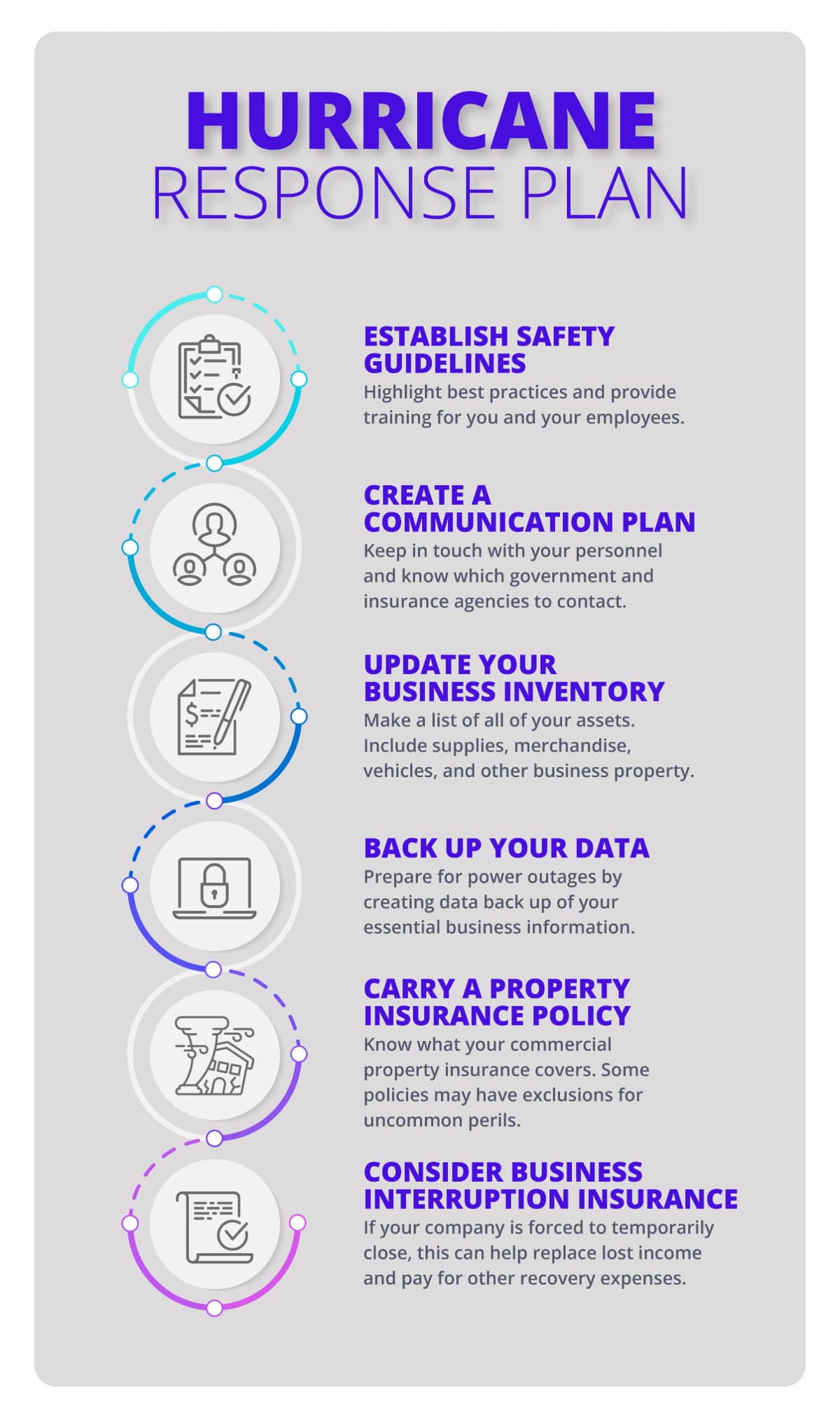
Hurricane insurance is only one part of a comprehensive hurricane risk management plan. To protect your business, especially if you live in a high-risk area, consider the following risk management steps:
- Develop an established policy and procedures to handle a natural disaster. Outline what your staff should do, where they should go, and how to stay safe during a hurricane.
- Do a safety walkthrough and ensure that your business is set up to handle a natural disaster. Ensure that there aren’t any electronics on the floor that could cause a fire or electrocution, that inventory is securely stored and won’t cause injury, and that exits are cleared of egress.
- Create a regular data backup system so your business information is secured on a cloud-based server in case of an electrical outage or computer system damage.
- Maintain good records. Ensure that business property and inventory levels are easily accessible during a natural disaster that damages property.
- Draft a disaster communication plan with emergency contacts. Make sure this is regularly updated.
When it comes to disaster preparedness, it’s always better to over-prepare rather than be blindsided without a plan.
How do I get business hurricane insurance?
To get a hurricane insurance policy for your small business, complete Insureon's easy online application. We'll connect you with free quotes from the nation's leading insurance companies.
You can also speak to one of our licensed insurance agents and they'll help you find the proper coverage for your needs.
After you find the right commercial hurricane insurance for your business, you can begin coverage and receive a certificate of insurance, often within a few hours.
Verified commercial property coverage reviews
Get insurance quotes for your small business



Want free expert advice right in your inbox?
By entering your email address and subscribing, you agree to our Terms of Use and Privacy Policy