


Get the right commercial insurance for your Minneapolis business



Which insurance policies are recommended for Minneapolis businesses?

General liability insurance
General liability pays for legal costs from customer accidents, along with defamation and copyright infringement claims. Commercial leases in Minneapolis often require this coverage.
- Customer accidents at your business
- Damage to a customer's property
- Slander and other advertising injuries

Professional liability insurance
A professional liability policy covers legal costs related to claims of negligence, such as advice that caused a client to lose money. It's sometimes called errors and omissions insurance (E&O).
- Mistakes that cause financial loss
- Accusations of professional negligence
- Missed deadlines

Cyber liability insurance
Cyber insurance helps small businesses in Charleston recover after a data breach or a cyberattack. Every business that handles customer information should have this coverage.
- Data breach notification costs
- Fraud monitoring services
- PR campaigns after a breach

Business owner’s policy
A business owner's policy is an affordable way to buy general liability coverage and commercial property insurance together. It's recommended for low-risk small businesses in Charleston.
- Customer slip-and-fall injuries
- Damaged business property
- Theft and vandalism

Workers’ compensation insurance
Workers' comp is required for Charleston businesses with employees, with few exceptions. It also covers work-related injuries for sole proprietors, which health insurance may deny.
- Medical bills from job-related injuries
- Disability benefits
- Legal fees from workplace injuries

Commercial auto insurance
All vehicles owned by Charleston businesses must be covered by commercial auto insurance. This policy primarily covers injuries and property damage caused by your vehicle.
- Injuries from an auto accident
- Damage caused by your vehicle
- Lawsuits from an auto accident

Errors and omissions insurance
E&O insurance protects consultants and professional services against legal defense costs from dissatisfied clients. It's also called professional liability insurance.
- Errors and oversights
- Breach of contract
- Professional negligence

Commercial property insurance
This policy covers physical damage to a Charleston business's building and its contents, including any computers and equipment. You can bundle it with general liability in a BOP.
- Burglaries
- Fires
- Storm damage

Commercial umbrella insurance
An umbrella policy provides coverage once the limit is reached on your underlying general liability insurance, commercial auto insurance, or employer's liability insurance.
- Customer lawsuits
- Auto accident lawsuits
- Employee injury lawsuits
Verified business insurance reviews
Hear from customers like you who purchased small business insurance.
Which business insurance policies are required in Minneapolis, MN?

Workers' compensation insurance
Minnesota state law requires workers' compensation for all small businesses with employees, whether they're full-time, part-time, temporary or seasonal. There are a few exceptions to this rule, including:
- Agriculture workers whose income doesn't exceed a certain income threshold
- Household workers employed in private homes who make less than $1,000 over 90 days
- Casual employees working outside of normal business hours on an infrequent basis
Workers' compensation helps pay for medical expenses related to work-related injuries.
Most workers' comp policies also include employer's liability coverage, which protects the business from injury-related lawsuits.
Single-person businesses, such as sole proprietors and independent contractors, should also carry workers' comp, though they are not required by state law. This policy can help with medical bills related to work injuries, or may be a requirement for certain contracts.
Commercial auto insurance
All Minnesota small businesses with company-owned vehicles are required to carry commercial auto insurance.
This insurance protects your business if you or your employees are involved in an accident with company vehicles while performing work-related activities and errands.
Minnesota insurance minimum requirements include:
- $30,000 bodily injury liability per person
- $60,000 bodily injury liability per accident
- $10,000 property damage liability
- $25,000 uninsured/underinsured motorist coverage per person
- $50,000 uninsured/underinsured motorist coverage per accident
- $40,000 personal injury protection
Certain businesses, such as trucking businesses or those that use utility trailers or cargo trailers, may require higher limits.
In Minnesota, personal injury protection (PIP) is also required as an endorsement to your coverage, and it helps provide medical payments coverage if there's an accident, regardless of who was the at-fault driver.
Businesses that use personal, rented, or leased vehicles will need another policy called a hired and non-owned (HNOA) policy.
How much does business insurance in Minneapolis cost?

Small businesses in Minneapolis don't have to pay a lot for commercial insurance. Here are a few average costs for Minnesota businesses, based on policy data from Insureon customers:
General liability: $41 per month
Workers' comp: $57 per month
Professional liability/E&O: $75 per month
The cost of business liability insurance depends on factors such as:
- Type of business
- Business operations
- Number of employees
- Policy limits and deductibles
- Claims history
Top professions we insure










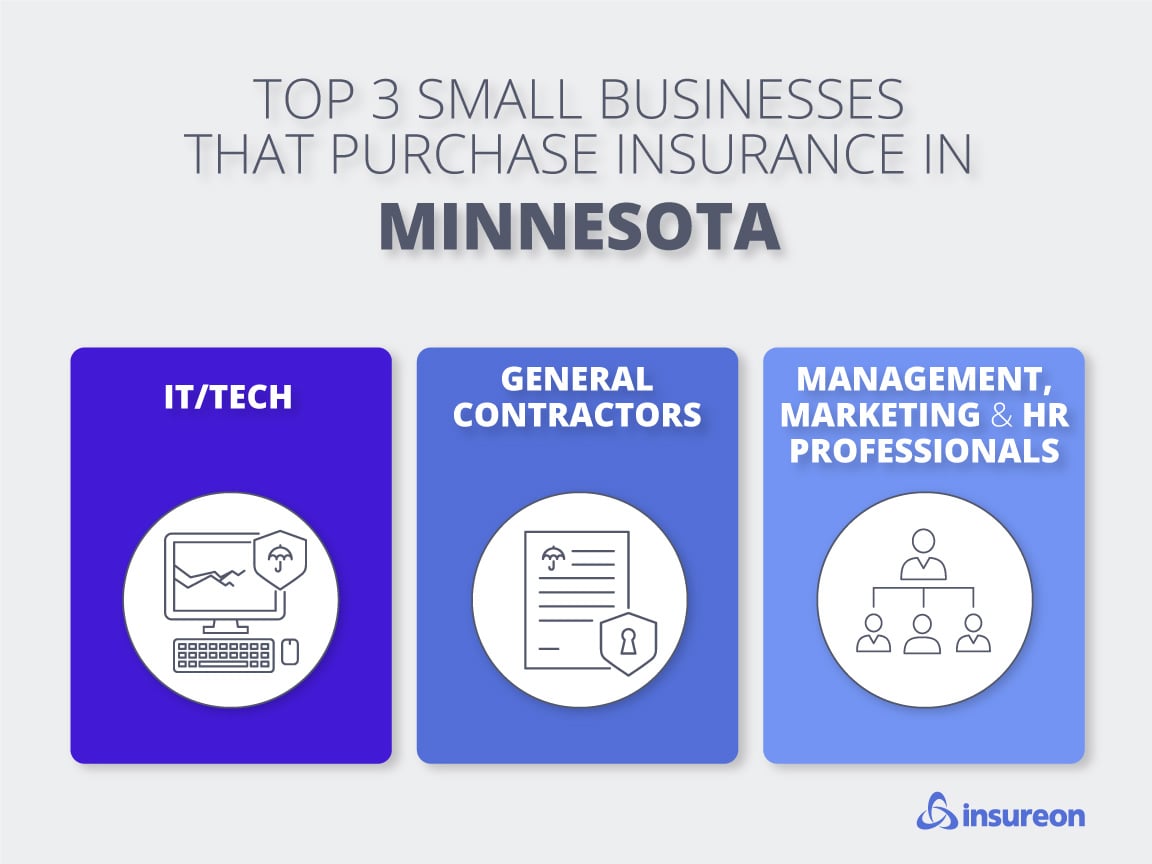
FAQs about Minneapolis business insurance
How do I get a certificate of insurance for my business?
With Insureon, you can get same-day insurance in three easy steps:
- Fill out our easy online application to get quotes from top-rated insurance carriers.
- Choose the insurance option that suits your coverage needs and pay for it online.
- Download a certificate of insurance (COI) by logging into your account.
Our licensed insurance agents will help you get coverage for your Minneapolis company that matches your specific business needs and your budget.
Most businesses can get their certificate of insurance within a few hours. With this certificate, you can demonstrate proof of insurance for contracts, bids, and other agreements.
Can my business be held liable for a data security breach?
Yes – that's why cyber insurance is so crucial. Small businesses are a common target of cyberattacks since they often have fewer security measures in place.
Small businesses are a common target of cyberattacks and ransomware attacks since they often have fewer security measures in place.
Minnesota data breach laws require Minneapolis businesses to notify any residents "in the most expedient time possible and without unreasonable delay" if they're exposed in a data breach.
Your business could also end up paying for a data breach investigation, a PR campaign, and other costs related to a breach or cyberattack.
Cyber insurance covers these costs and provides resources so you can get back to business fast.
Does my industry affect Minneapolis insurance requirements?
Minneapolis does not have a standard city business license for all small businesses, but there may be special requirements for business insurance and bonds, depending on the type of work you do.
Additionally, certain industries, such as businesses that sell alcohol, tattoo shops, and restaurants are required to carry a license.
Here are a few examples of businesses with other obligations:
- Contractors need commercial general liability insurance for contractors to operate in Minnesota. They might also need a surety bond to sign a contract or bid on a project.
- Real estate agents and brokers are not required to carry professional liability insurance but the firm where they work may require it.
- Notaries public in Minnesota are not required to carry insurance or surety bonds, but it's highly recommended.
- Cannabis dispensaries in Minnesota aren't required to carry insurance but may want to consider additional policies to address the increased risk of the cannabis industry.
- Physicians aren't required by law to carry malpractice insurance in Minnesota, but some healthcare facilities require it.
When running a business in Minneapolis, you need to be aware of laws and regulations for Minnesota, the city of Minneapolis, and Hennepin County.
How can I get help starting a small business in Minneapolis, MN?
The City of Minneapolis provides ample support for new and growing small businesses.
Here's a list of local organizations available to provide guidance and resources:
- The Small Business Assistance Office offered through the Minnesota Employment and Economic Development department provides consultation services, licensing support, newsletters, financing programs, and more.
- The City of Minneapolis provides business resources including financing support, technical assistance, and industry-specific guides for small business owners.
- SCORE Twin Cities works with local Minneapolis small business owners to provide mentorship and education.
- The Minnesota Secretary of State provides resources for small businesses in Minneapolis, St. Paul, Duluth, and elsewhere in the state.
- The U.S. Small Business Administration Minnesota District offers events, guides, and education for small business owners in Minneapolis and beyond.
- Rutgers School of Management and Labor Relations assists local businesses with educational and growth opportunities.
Keep in mind that many lenders will require you to first obtain business insurance coverage before they will approve a loan.
How can I save money on Minneapolis business insurance?
Small business owners can save money on insurance by comparing quotes from different insurance companies.
With Insureon, you can get free Minnesota business insurance quotes from top-rated providers by filling out one easy application.
There are a few other ways to save, such as:
- Bundle policies for a discount. The most popular option is a business owner's policy.
- Choose less expensive policy options, such as lower limits or a higher deductible.
- Focus on minimizing workplace exposures and risk management. Fewer accidents mean fewer claims, which helps keep your premium low.
Learn more about how to find cheap business insurance. You can also speak to one of Insureon's agents to discuss your insurance coverage needs.